Question 4
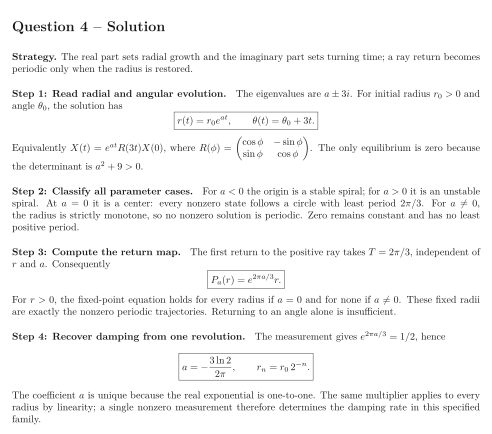
For , consider For , define the positive-axis return map as the radius the solution starting at has on its first later return to the positive -axis. A return to this ray need not be a return to the same point.
Tasks
Find the eigenvalues and the solution from an arbitrary nonzero initial state in polar form.
Classify the origin for , , and . Determine exactly when a nonzero solution is periodic.
Find the first return time, the map , and all its fixed radii in . Explain their relation to periodic trajectories.
An experiment finds for one nonzero radius. Recover , and find the radius after complete turns for every integer .
Show solutionHide solution
Question 4 – Solution
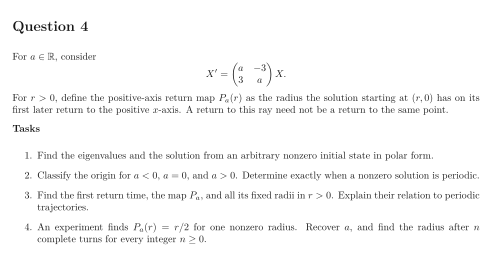
Strategy. The real part sets radial growth and the imaginary part sets turning time; a ray return becomes periodic only when the radius is restored.
Step 1: Read radial and angular evolution. The eigenvalues are . For initial radius and angle , the solution has Equivalently , where . The only equilibrium is zero because the determinant is .
Step 2: Classify all parameter cases. For the origin is a stable spiral; for it is an unstable spiral. At it is a center: every nonzero state follows a circle with least period . For , the radius is strictly monotone, so no nonzero solution is periodic. Zero remains constant and has no least positive period.
Step 3: Compute the return map. The first return to the positive ray takes , independent of and . Consequently For , the fixed-point equation holds for every radius if and for none if . These fixed radii are exactly the nonzero periodic trajectories. Returning to an angle alone is insufficient.
Step 4: Recover damping from one revolution. The measurement gives , hence The coefficient is unique because the real exponential is one-to-one. The same multiplier applies to every radius by linearity; a single nonzero measurement therefore determines the damping rate in this specified family.