Question 6
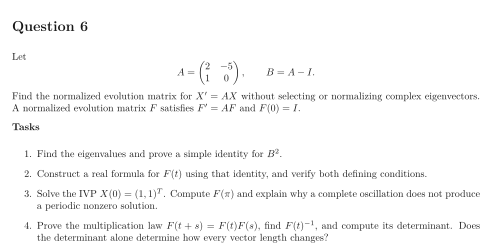
Let Find the normalized evolution matrix for without selecting or normalizing complex eigenvectors. A normalized evolution matrix satisfies and .
Tasks
Find the eigenvalues and prove a simple identity for .
Construct a real formula for using that identity, and verify both defining conditions.
Solve the IVP . Compute and explain why a complete oscillation does not produce a periodic nonzero solution.
Prove the multiplication law , find , and compute its determinant. Does the determinant alone determine how every vector length changes?
Show solutionHide solution
Question 6 – Solution
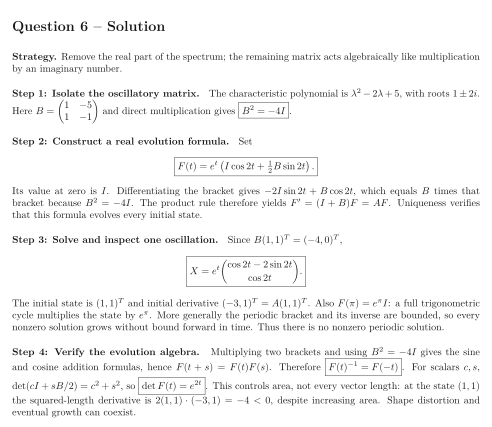
Strategy. Remove the real part of the spectrum; the remaining matrix acts algebraically like multiplication by an imaginary number.
Step 1: Isolate the oscillatory matrix. The characteristic polynomial is , with roots . Here and direct multiplication gives .
Step 2: Construct a real evolution formula. Set Its value at zero is . Differentiating the bracket gives , which equals times that bracket because . The product rule therefore yields . Uniqueness verifies that this formula evolves every initial state.
Step 3: Solve and inspect one oscillation. Since , The initial state is and initial derivative . Also : a full trigonometric cycle multiplies the state by . More generally the periodic bracket and its inverse are bounded, so every nonzero solution grows without bound forward in time. Thus there is no nonzero periodic solution.
Step 4: Verify the evolution algebra. Multiplying two brackets and using gives the sine and cosine addition formulas, hence . Therefore . For scalars , , so . This controls area, not every vector length: at the state the squared-length derivative is , despite increasing area. Shape distortion and eventual growth can coexist.