Question 8
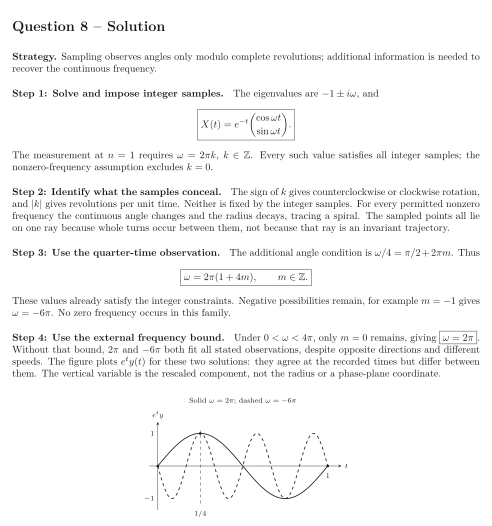
For a nonzero real frequency , consider An instrument records only selected times. At every integer it reports . Assume the measurements are exact.
Tasks
Solve the IVP and determine every nonzero frequency consistent with all the integer-time measurements.
Can these measurements determine rotation direction or the number of revolutions per unit time? Explain why the observed points do not imply a straight-line continuous trajectory.
An additional measurement is . Find every frequency still allowed, including negative frequencies.
If one also knows , recover the frequency uniquely. Exhibit two different frequencies that fit both sets of measurements when that extra bound is absent.
Show solutionHide solution
Question 8 – Solution
Strategy. Sampling observes angles only modulo complete revolutions; additional information is needed to recover the continuous frequency.
Step 1: Solve and impose integer samples. The eigenvalues are , and The measurement at requires , . Every such value satisfies all integer samples; the nonzero-frequency assumption excludes .
Step 2: Identify what the samples conceal. The sign of gives counterclockwise or clockwise rotation, and gives revolutions per unit time. Neither is fixed by the integer samples. For every permitted nonzero frequency the continuous angle changes and the radius decays, tracing a spiral. The sampled points all lie on one ray because whole turns occur between them, not because that ray is an invariant trajectory.
Step 3: Use the quarter-time observation. The additional angle condition is . Thus These values already satisfy the integer constraints. Negative possibilities remain, for example gives . No zero frequency occurs in this family.
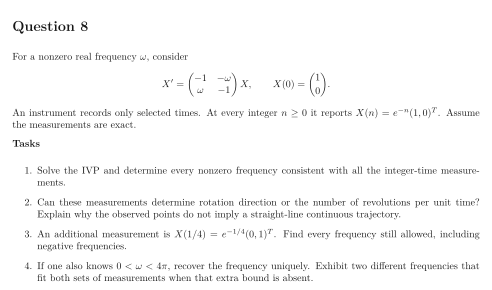
Step 4: Use the external frequency bound. Under , only remains, giving . Without that bound, and both fit all stated observations, despite opposite directions and different speeds. The figure plots for these two solutions: they agree at the recorded times but differ between them. The vertical variable is the rescaled component, not the radius or a phase-plane coordinate.
See the diagram in the original worksheet below.