Question 9
Consider Use Euclidean boundedness on or as appropriate. For a nonzero state its direction means the normalized vector .
Tasks
Find the eigenvalues and the complete real solution for arbitrary initial data.
Classify the initial states giving bounded solutions forward in time, backward in time, or for all real time.
When , determine the limiting direction as and justify why the rotating components do not affect it.
When but , determine the state limit and decide whether its direction has a limit. Give a sequence-based justification.
Show solutionHide solution
Question 9 – Solution
Strategy. Decouple the rotating plane from the real exponential axis, and distinguish convergence of a state from convergence of its direction.
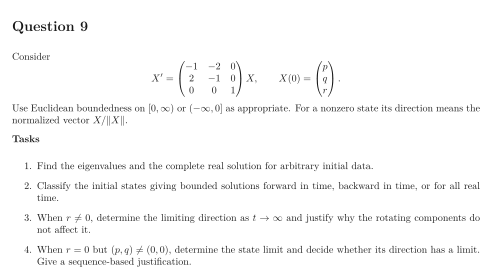
Step 1: Separate the blocks. The eigenvalues are and . The complete solution is The planar rotation is invertible at every time, so the arbitrary three initial components are represented without loss.
Step 2: Classify boundedness in both time directions. Exactly gives forward boundedness. For backward boundedness, forces ; the remaining component then tends to zero backward. The intersection of this axis with the forward-bounded plane is zero, so is the only solution bounded on the entire real line. Rotation cannot cancel the planar radius.
Step 3: Find the direction with an unstable component. If , the ratio of planar radius to is . Consequently . The state itself grows without bound; its direction can still converge because the real growing mode dominates both decaying components.
Step 4: Test direction on the stable plane. If and , then , but its normalized planar state is . At it equals ; at it equals its negative. Both sequences tend to infinity and the two unit vectors are distinct, so no directional limit exists. At the direction is perpendicular to its value at , so even the unoriented line of approach has no limit. A convergent state need not behave like a nonzero real dominant eigenmode.