Question 10
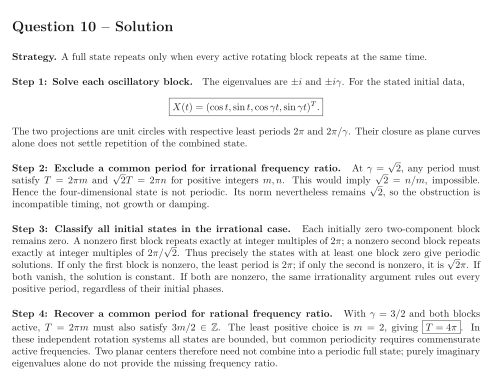
For , consider the four-dimensional system A state is periodic if there is with for all real . A constant solution has no least positive period.
Tasks
Find the eigenvalues and solve the IVP . Describe its projections onto the two coordinate planes.
For , prove that this full state is not periodic, even though both planar projections are periodic.
Still with , classify exactly which arbitrary initial states give periodic solutions, and give their least periods when nonconstant.
Replace by . Find the least period for the stated IVP and explain why purely imaginary eigenvalues alone do not guarantee a common period in higher dimensions.
Show solutionHide solution
Question 10 – Solution
Strategy. A full state repeats only when every active rotating block repeats at the same time.
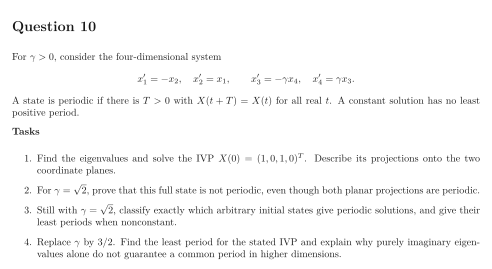
Step 1: Solve each oscillatory block. The eigenvalues are and . For the stated initial data, The two projections are unit circles with respective least periods and . Their closure as plane curves alone does not settle repetition of the combined state.
Step 2: Exclude a common period for irrational frequency ratio. At , any period must satisfy and for positive integers . This would imply , impossible. Hence the four-dimensional state is not periodic. Its norm nevertheless remains , so the obstruction is incompatible timing, not growth or damping.
Step 3: Classify all initial states in the irrational case. Each initially zero two-component block remains zero. A nonzero first block repeats exactly at integer multiples of ; a nonzero second block repeats exactly at integer multiples of . Thus precisely the states with at least one block zero give periodic solutions. If only the first block is nonzero, the least period is ; if only the second is nonzero, it is . If both vanish, the solution is constant. If both are nonzero, the same irrationality argument rules out every positive period, regardless of their initial phases.
Step 4: Recover a common period for rational frequency ratio. With and both blocks active, must also satisfy . The least positive choice is , giving . In these independent rotation systems all states are bounded, but common periodicity requires commensurate active frequencies. Two planar centers therefore need not combine into a periodic full state; purely imaginary eigenvalues alone do not provide the missing frequency ratio.