Question 2
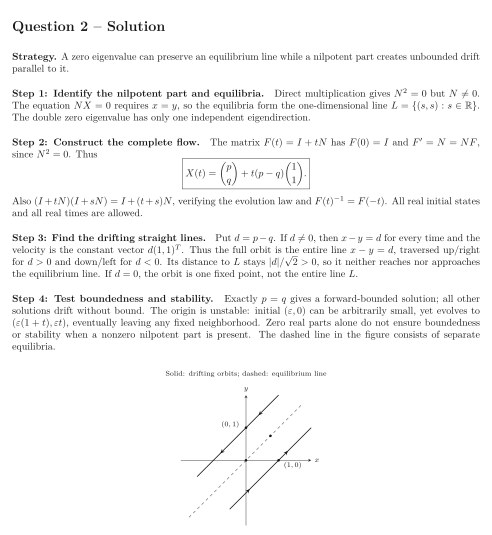
Let Both eigenvalues are zero. A matrix is nilpotent if some positive power of it is zero; investigate the effect on the actual motion.
Tasks
Compute , find the entire equilibrium set, and determine its dimension.
Find the normalized evolution matrix and the solution from arbitrary . Verify the evolution law directly.
For initial data outside the equilibrium line, find the phase trajectory and its time direction. Can it reach that line at a finite or infinite forward time?
Classify all forward-bounded solutions. Decide whether the origin is stable in the sense that sufficiently small initial states remain small for all .
Show solutionHide solution
Question 2 – Solution
Strategy. A zero eigenvalue can preserve an equilibrium line while a nilpotent part creates unbounded drift parallel to it.
Step 1: Identify the nilpotent part and equilibria. Direct multiplication gives but . The equation requires , so the equilibria form the one-dimensional line . The double zero eigenvalue has only one independent eigendirection.
Step 2: Construct the complete flow. The matrix has and , since . Thus Also , verifying the evolution law and . All real initial states and all real times are allowed.
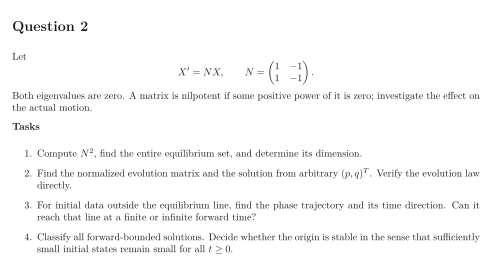
Step 3: Find the drifting straight lines. Put . If , then for every time and the velocity is the constant vector . Thus the full orbit is the entire line , traversed up/right for and down/left for . Its distance to stays , so it neither reaches nor approaches the equilibrium line. If , the orbit is one fixed point, not the entire line .
Step 4: Test boundedness and stability. Exactly gives a forward-bounded solution; all other solutions drift without bound. The origin is unstable: initial can be arbitrarily small, yet evolves to , eventually leaving any fixed neighborhood. Zero real parts alone do not ensure boundedness or stability when a nonzero nilpotent part is present. The dashed line in the figure consists of separate equilibria.
See the diagram in the original worksheet below.