Question 10
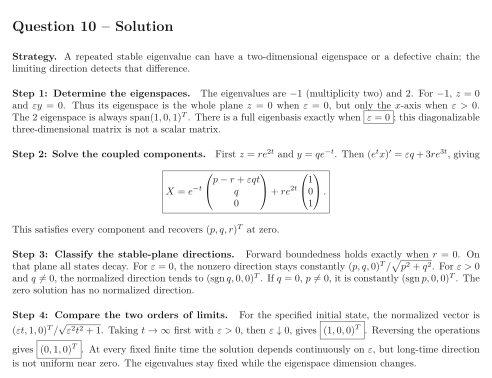
For , consider A matrix is diagonalizable if it has a basis of eigenvectors. For nonzero solutions, compare their normalized directions .
Tasks
Find the eigenvalues and eigenspaces. For which is the matrix diagonalizable?
Find the complete solution for arbitrary initial data, including the polynomial term when present.
Identify all forward-bounded initial states. Within that set, classify the limiting forward directions for every nonzero initial state.
For initial , compare the iterated limits of as and , in both orders. Explain what changes even though the eigenvalues do not.
Show solutionHide solution
Question 10 – Solution
Strategy. A repeated stable eigenvalue can have a two-dimensional eigenspace or a defective chain; the limiting direction detects that difference.
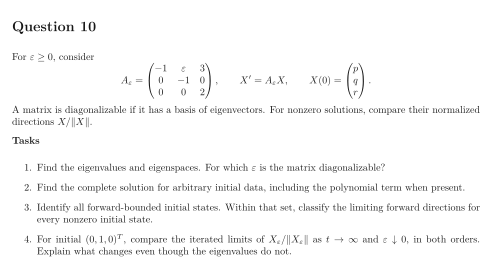
Step 1: Determine the eigenspaces. The eigenvalues are (multiplicity two) and . For , and . Thus its eigenspace is the whole plane when , but only the -axis when . The eigenspace is always . There is a full eigenbasis exactly when ; this diagonalizable three-dimensional matrix is not a scalar matrix.
Step 2: Solve the coupled components. First and . Then , giving This satisfies every component and recovers at zero.
Step 3: Classify the stable-plane directions. Forward boundedness holds exactly when . On that plane all states decay. For , the nonzero direction stays constantly . For and , the normalized direction tends to . If , , it is constantly . The zero solution has no normalized direction.
Step 4: Compare the two orders of limits. For the specified initial state, the normalized vector is . Taking first with , then , gives . Reversing the operations gives . At every fixed finite time the solution depends continuously on , but long-time direction is not uniform near zero. The eigenvalues stay fixed while the eigenspace dimension changes.