Question 2
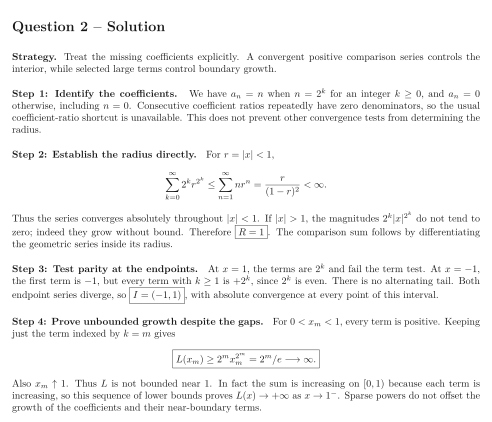
A power series with large gaps between nonzero coefficients is written as The first terms are . Use the ordinary definition of a power series even though many coefficients vanish.
Tasks
Write its coefficient rule in the form . Explain why applying to all consecutive coefficients is inappropriate.
Prove the exact radius using comparison when and the necessary term test when .
Test both endpoints, paying attention to the parity of . Does the endpoint produce an alternating tail?
Let for integers . Use a single term to bound from below, and decide whether the sparse exponents make bounded as .
Show solutionHide solution
Question 2 – Solution
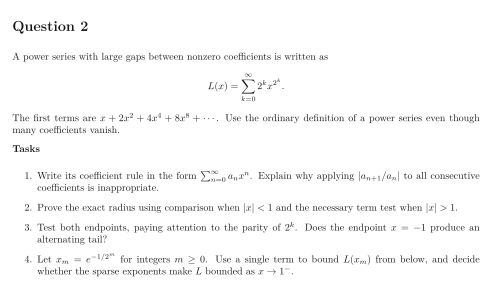
Strategy. Treat the missing coefficients explicitly. A convergent positive comparison series controls the interior, while selected large terms control boundary growth.
Step 1: Identify the coefficients. We have when for an integer , and otherwise, including . Consecutive coefficient ratios repeatedly have zero denominators, so the usual coefficient-ratio shortcut is unavailable. This does not prevent other convergence tests from determining the radius.
Step 2: Establish the radius directly. For , Thus the series converges absolutely throughout . If , the magnitudes do not tend to zero; indeed they grow without bound. Therefore . The comparison sum follows by differentiating the geometric series inside its radius.
Step 3: Test parity at the endpoints. At , the terms are and fail the term test. At , the first term is , but every term with is , since is even. There is no alternating tail. Both endpoint series diverge, so , with absolute convergence at every point of this interval.
Step 4: Prove unbounded growth despite the gaps. For , every term is positive. Keeping just the term indexed by gives Also . Thus is not bounded near . In fact the sum is increasing on because each term is increasing, so this sequence of lower bounds proves as . Sparse powers do not offset the growth of the coefficients and their near-boundary terms.