Question 3
For , define Near the origin the numerator suffers substantial cancellation.
Tasks
Derive the full Maclaurin series of by combining the sine and cosine series before dividing. State its convergence domain.
Determine the unique continuous extension at , and find and for that extension.
Construct its fourth-degree Taylor polynomial and certify its absolute error on by an alternating-series estimate.
Prove that the extended function is even and strictly positive on . Explain why the series is useful for evaluating the original quotient near .
Show solutionHide solution
Question 3 – Solution
Strategy. Expose the first nonzero numerator term before removing the apparent singularity.
Step 1: Cancel and reindex. The coefficient of in the numerator is . It is zero when . Setting for the surviving terms gives Sine and cosine converge absolutely for every real ; the new series also has infinite radius by the ratio test. It agrees with the quotient when .
Step 2: Fill the removable singularity. The new series defines an analytic extension with Continuity forces the value , so no other continuous extension is possible.
Step 3: Bound the truncated tail. The polynomial is . For , successive term magnitudes have ratio . They decrease to zero, so
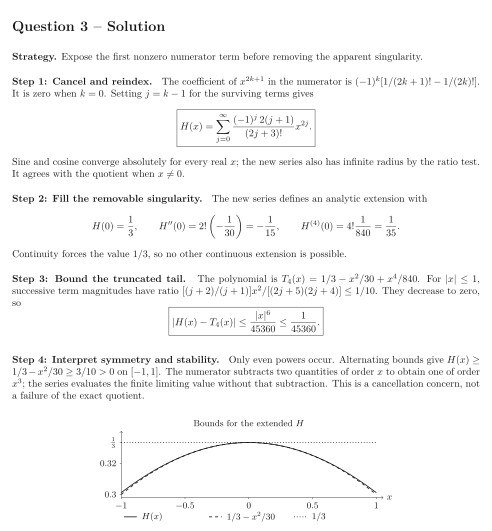
Step 4: Interpret symmetry and stability. Only even powers occur. Alternating bounds give on . The numerator subtracts two quantities of order to obtain one of order ; the series evaluates the finite limiting value without that subtraction. This is a cancellation concern, not a failure of the exact quotient.
See the diagram in the original worksheet below.