Question 6
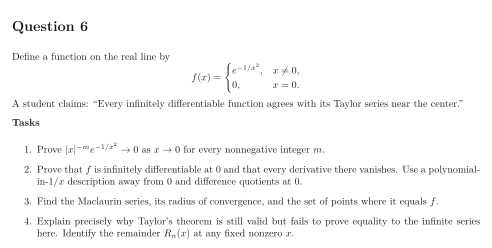
Define a function on the real line by A student claims: “Every infinitely differentiable function agrees with its Taylor series near the center.”
Tasks
Prove as for every nonnegative integer .
Prove that is infinitely differentiable at and that every derivative there vanishes. Use a polynomial-in- description away from and difference quotients at .
Find the Maclaurin series, its radius of convergence, and the set of points where it equals .
Explain precisely why Taylor’s theorem is still valid but fails to prove equality to the infinite series here. Identify the remainder at any fixed nonzero .
Show solutionHide solution
Question 6 – Solution
Strategy. Separate the existence of every derivative from the limiting behavior of the Taylor remainders.
Step 1: Exponential decay beats every power. Put . Choose an integer . Since ,
Step 2: Prove smoothness, including the center. For , induction gives , where and Define each candidate derivative to be zero at . Step 1 proves its continuity there. Its difference quotient at is , again by Step 1. Inductively each candidate is the derivative of the preceding one, so and for every .
Step 3: Compare the series with the function. Every Taylor polynomial is zero. Thus the Maclaurin series is , with infinite radius. It equals only at , since for every nonzero . Infinite radius does not by itself identify the represented function.
Step 4: Locate the missing hypothesis. Taylor’s finite theorem remains valid on the segment from to any fixed . But for , independently of . Thus . Smoothness provides each finite remainder formula, not a derivative-growth bound forcing remainders to vanish. The graph and the zero Taylor sum touch to every order at without agreeing nearby.
See the diagram in the original worksheet below.
