Question 3
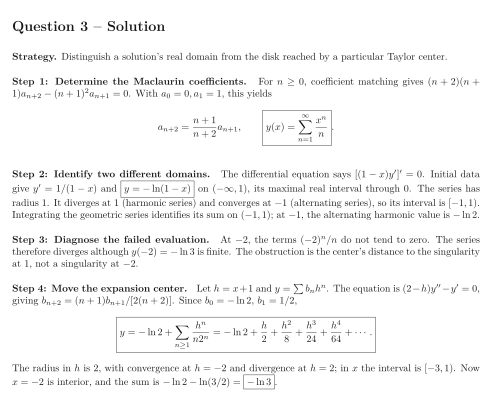
Solve the initial-value problem by a series about , then investigate what happens when that series is used far from its center.
Tasks
Derive the recurrence and determine every Maclaurin coefficient.
Identify the represented function and its maximal real interval containing . Independently determine the power series’ radius and both endpoint outcomes.
Explain why the initial series fails at even though the solution exists there. Is this a singularity of the solution at ?
Reexpand about , deriving the new coefficient recurrence from the differential equation. Give the first four nonconstant terms, the new convergence interval including endpoints, and the value at .
Show solutionHide solution
Question 3 – Solution
Strategy. Distinguish a solution’s real domain from the disk reached by a particular Taylor center.
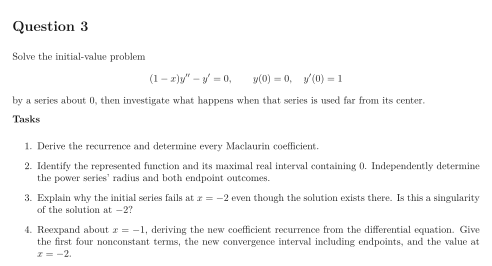
Step 1: Determine the Maclaurin coefficients. For , coefficient matching gives . With , this yields
Step 2: Identify two different domains. The differential equation says . Initial data give and on , its maximal real interval through . The series has radius . It diverges at (harmonic series) and converges at (alternating series), so its interval is . Integrating the geometric series identifies its sum on ; at , the alternating harmonic value is .
Step 3: Diagnose the failed evaluation. At , the terms do not tend to zero. The series therefore diverges although is finite. The obstruction is the center’s distance to the singularity at , not a singularity at .
Step 4: Move the expansion center. Let and . The equation is , giving . Since , , The radius in is , with convergence at and divergence at ; in the interval is . Now is interior, and the sum is .