Question 8
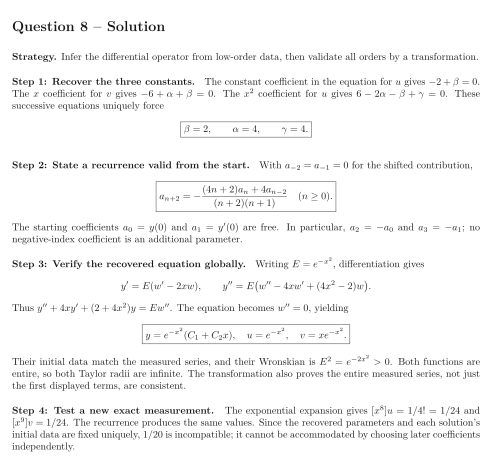
An unknown equation has the form where are real constants. Two analytic solutions have measured Taylor expansions The displayed coefficients are exact.
Tasks
Determine by substituting only the coefficients needed from these data. Show the recovery is unique.
Derive the full recurrence for a generic series solution of the recovered equation, including its conventions at the lowest indices.
Use the substitution to identify every solution exactly. Verify that the two measured series are a fundamental pair and determine their radii of convergence.
Predict the coefficients of in and in . Can an additional exact measurement assigning the value to the former coefficient be consistent with the equation and the original data?
Show solutionHide solution
Question 8 – Solution
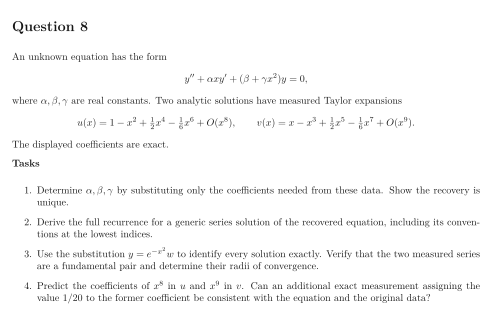
Strategy. Infer the differential operator from low-order data, then validate all orders by a transformation.
Step 1: Recover the three constants. The constant coefficient in the equation for gives . The coefficient for gives . The coefficient for gives . These successive equations uniquely force
Step 2: State a recurrence valid from the start. With for the shifted contribution, The starting coefficients and are free. In particular, and ; no negative-index coefficient is an additional parameter.
Step 3: Verify the recovered equation globally. Writing , differentiation gives Thus . The equation becomes , yielding Their initial data match the measured series, and their Wronskian is . Both functions are entire, so both Taylor radii are infinite. The transformation also proves the entire measured series, not just the first displayed terms, are consistent.
Step 4: Test a new exact measurement. The exponential expansion gives and . The recurrence produces the same values. Since the recovered parameters and each solution’s initial data are fixed uniquely, is incompatible; it cannot be accommodated by choosing later coefficients independently.