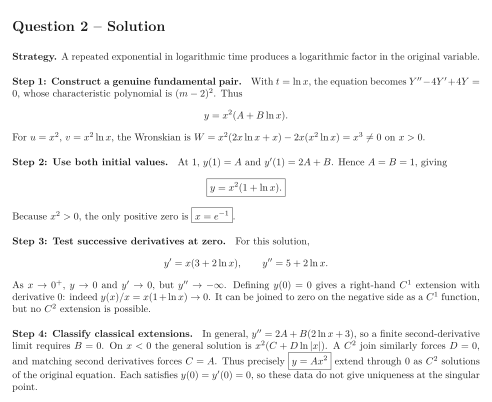
Question 2
For , consider A repeated characteristic exponent needs a second independent solution and careful treatment at the singular point.
Tasks
Derive the repeated exponent and obtain a second independent solution using logarithmic coordinates. Verify independence rather than merely listing two functions.
Solve the IVP and find every positive zero of its solution.
Determine whether this IVP solution admits a continuous, , or extension to . Compute the relevant one-sided limits.
For the general positive-half-line solution, classify which choices permit a extension through that solves the original equation. Explain whether the data determine that extension uniquely.
Show solutionHide solution
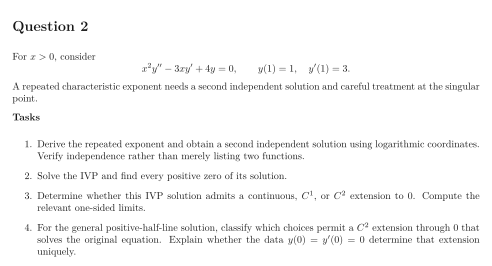
Question 2 – Solution
Strategy. A repeated exponential in logarithmic time produces a logarithmic factor in the original variable.
Step 1: Construct a genuine fundamental pair. With , the equation becomes , whose characteristic polynomial is . Thus For , , the Wronskian is on .
Step 2: Use both initial values. At , and . Hence , giving Because , the only positive zero is .
Step 3: Test successive derivatives at zero. For this solution, As , and , but . Defining gives a right-hand extension with derivative : indeed . It can be joined to zero on the negative side as a function, but no extension is possible.
Step 4: Classify classical extensions. In general, , so a finite second-derivative limit requires . On the general solution is . A join similarly forces , and matching second derivatives forces . Thus precisely extend through as solutions of the original equation. Each satisfies , so these data do not give uniqueness at the singular point.