Question 1
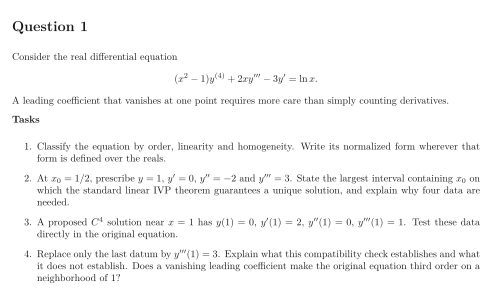
Consider the real differential equation A leading coefficient that vanishes at one point requires more care than simply counting derivatives.
Tasks
Classify the equation by order, linearity and homogeneity. Write its normalized form wherever that form is defined over the reals.
At , prescribe , , and . State the largest interval containing on which the standard linear IVP theorem guarantees a unique solution, and explain why four data are needed.
A proposed solution near has , , , . Test these data directly in the original equation.
Replace only the last datum by . Explain what this compatibility check establishes and what it does not establish. Does a vanishing leading coefficient make the original equation third order on a neighborhood of ?
Show solutionHide solution
Question 1 – Solution
Strategy. Separate the equation’s order from the intervals on which its highest derivative can be isolated.
Step 1: Classify and normalize. This is a fourth-order, linear, nonhomogeneous equation: coefficients depend only on , and the forcing is not identically zero. For , , The coefficients of and are zero. The logarithm excludes ; normalization additionally excludes .
Step 2: Apply the theorem on its proper interval. All normalized coefficients and the forcing are continuous on , the largest such interval through . The linear IVP theorem gives one solution for arbitrary values of at that ordinary point. These four data specify the fourth-order initial state. The theorem does not assert that this particular solution cannot extend beyond the interval; it simply gives no guarantee across .
Step 3: Check the singular-point constraint. At , any solution must satisfy The proposed data give , not zero. They are impossible for a classical solution of the original equation near .
Step 4: Interpret compatibility without overclaiming. With , the same test gives . This removes that contradiction, but alone proves neither existence nor uniqueness; the normalized IVP theorem still does not apply at . The coefficient of is nonzero at nearby points other than , so the equation remains fourth order on a neighborhood. At the isolated point, its value imposes a lower-derivative constraint instead of determining .
See the diagram in the original worksheet below.
