Question 1
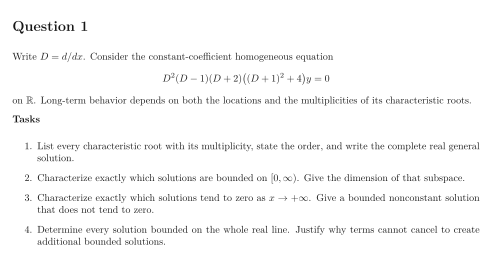
Write . Consider the constant-coefficient homogeneous equation on . Long-term behavior depends on both the locations and the multiplicities of its characteristic roots.
Tasks
List every characteristic root with its multiplicity, state the order, and write the complete real general solution.
Characterize exactly which solutions are bounded on . Give the dimension of that subspace.
Characterize exactly which solutions tend to zero as . Give a bounded nonconstant solution that does not tend to zero.
Determine every solution bounded on the whole real line. Justify why terms cannot cancel to create additional bounded solutions.
Show solutionHide solution
Question 1 – Solution
Strategy. Separate exponential growth, polynomial drift, decay and oscillation before imposing boundedness.
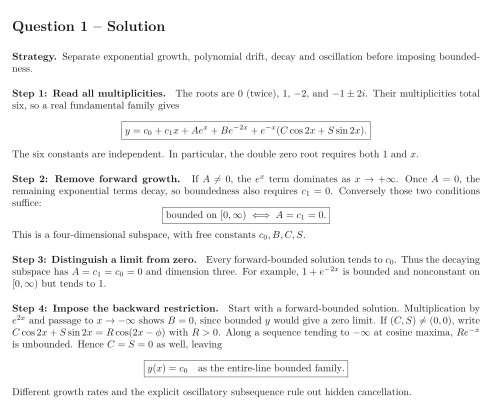
Step 1: Read all multiplicities. The roots are (twice), , , and . Their multiplicities total six, so a real fundamental family gives The six constants are independent. In particular, the double zero root requires both and .
Step 2: Remove forward growth. If , the term dominates as . Once , the remaining exponential terms decay, so boundedness also requires . Conversely those two conditions suffice: This is a four-dimensional subspace, with free constants .
Step 3: Distinguish a limit from zero. Every forward-bounded solution tends to . Thus the decaying subspace has and dimension three. For example, is bounded and nonconstant on but tends to .
Step 4: Impose the backward restriction. Start with a forward-bounded solution. Multiplication by and passage to shows , since bounded would give a zero limit. If , write with . Along a sequence tending to at cosine maxima, is unbounded. Hence as well, leaving Different growth rates and the explicit oscillatory subsequence rule out hidden cancellation.