Question 6
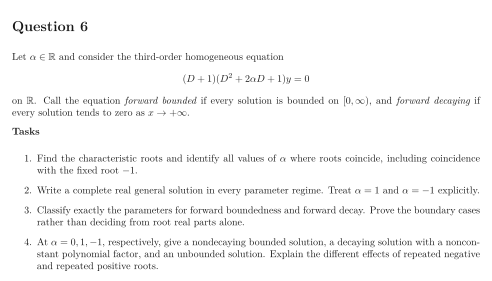
Let and consider the third-order homogeneous equation on . Call the equation forward bounded if every solution is bounded on , and forward decaying if every solution tends to zero as .
Tasks
Find the characteristic roots and identify all values of where roots coincide, including coincidence with the fixed root .
Write a complete real general solution in every parameter regime. Treat and explicitly.
Classify exactly the parameters for forward boundedness and forward decay. Prove the boundary cases rather than deciding from root real parts alone.
At , respectively, give a nondecaying bounded solution, a decaying solution with a nonconstant polynomial factor, and an unbounded solution. Explain the different effects of repeated negative and repeated positive roots.
Show solutionHide solution
Question 6 – Solution
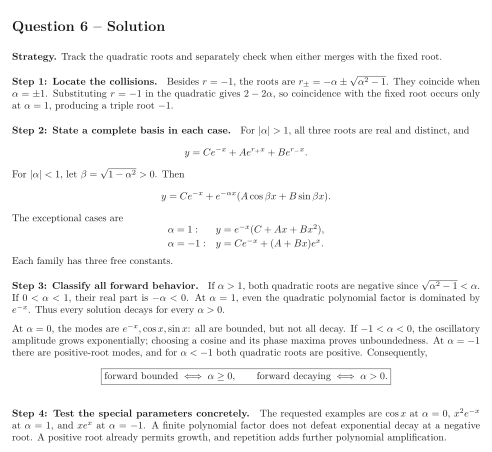
Strategy. Track the quadratic roots and separately check when either merges with the fixed root.
Step 1: Locate the collisions. Besides , the roots are . They coincide when . Substituting in the quadratic gives , so coincidence with the fixed root occurs only at , producing a triple root .
Step 2: State a complete basis in each case. For , all three roots are real and distinct, and For , let . Then The exceptional cases are Each family has three free constants.
Step 3: Classify all forward behavior. If , both quadratic roots are negative since . If , their real part is . At , even the quadratic polynomial factor is dominated by . Thus every solution decays for every .
At , the modes are : all are bounded, but not all decay. If , the oscillatory amplitude grows exponentially; choosing a cosine and its phase maxima proves unboundedness. At there are positive-root modes, and for both quadratic roots are positive. Consequently,
Step 4: Test the special parameters concretely. The requested examples are at , at , and at . A finite polynomial factor does not defeat exponential decay at a negative root. A positive root already permits growth, and repetition adds further polynomial amplification.