Question 8
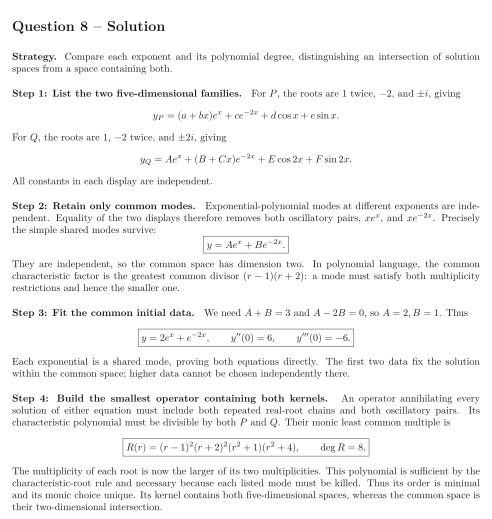
Consider two homogeneous constant-coefficient operators A common solution must satisfy both and on .
Tasks
Write the complete real general solution of each equation separately.
Determine the full common solution space and its dimension. Justify why the smaller multiplicity at each shared root is the relevant one.
Find the common solution with and . Compute the higher initial derivatives and that are then forced.
Find the monic real constant-coefficient operator of smallest order that annihilates every solution of either equation. Explain why this last requirement uses larger multiplicities and differs from finding common solutions.
Show solutionHide solution
Question 8 – Solution
Strategy. Compare each exponent and its polynomial degree, distinguishing an intersection of solution spaces from a space containing both.
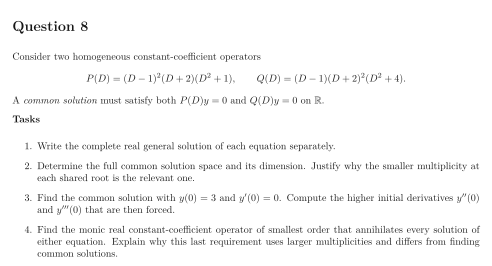
Step 1: List the two five-dimensional families. For , the roots are twice, , and , giving For , the roots are , twice, and , giving All constants in each display are independent.
Step 2: Retain only common modes. Exponential-polynomial modes at different exponents are independent. Equality of the two displays therefore removes both oscillatory pairs, , and . Precisely the simple shared modes survive: They are independent, so the common space has dimension two. In polynomial language, the common characteristic factor is the greatest common divisor : a mode must satisfy both multiplicity restrictions and hence the smaller one.
Step 3: Fit the common initial data. We need and , so . Thus Each exponential is a shared mode, proving both equations directly. The first two data fix the solution within the common space; higher data cannot be chosen independently there.
Step 4: Build the smallest operator containing both kernels. An operator annihilating every solution of either equation must include both repeated real-root chains and both oscillatory pairs. Its characteristic polynomial must be divisible by both and . Their monic least common multiple is The multiplicity of each root is now the larger of its two multiplicities. This polynomial is sufficient by the characteristic-root rule and necessary because each listed mode must be killed. Thus its order is minimal and its monic choice unique. Its kernel contains both five-dimensional spaces, whereas the common space is their two-dimensional intersection.