Question 10
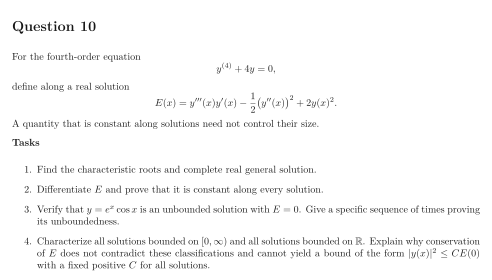
For the fourth-order equation define along a real solution A quantity that is constant along solutions need not control their size.
Tasks
Find the characteristic roots and complete real general solution.
Differentiate and prove that it is constant along every solution.
Verify that is an unbounded solution with . Give a specific sequence of times proving its unboundedness.
Characterize all solutions bounded on and all solutions bounded on . Explain why conservation of does not contradict these classifications and cannot yield a bound of the form with a fixed positive for all solutions.
Show solutionHide solution
Question 10 – Solution
Strategy. Compare the root-based behavior with what the conserved expression actually measures.
Step 1: Find growing and decaying oscillatory modes. Since , the roots are and . Thus All roots are simple and the four real modes are independent.
Step 2: Verify the conservation law. The product rule gives exact cancellation: Hence for every .
Step 3: Test a zero-level growing solution. For , the successive derivatives are At zero its initial vector is , so . Conservation yields . Yet , proving unboundedness.
Step 4: Identify the limits of the invariant. On boundedness requires : any nonzero growing sinusoid attains its amplitude along an unbounded sequence, while the other term decays. These conditions also suffice, giving a two-dimensional decaying family. Requiring boundedness backward as well forces by the same phase argument, so the only entire-line bounded solution is zero.
The expression is not positive definite in the four initial derivatives: it has a mixed product and a negative square. In particular a nonzero state can have . The displayed solution has and , immediately refuting the proposed bound for every positive . Constancy of an indefinite expression does not guarantee bounded motion.
See the diagram in the original worksheet below.
