Question 2
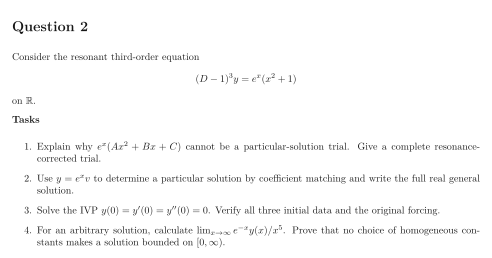
Consider the resonant third-order equation on .
Tasks
Explain why cannot be a particular-solution trial. Give a complete resonance-corrected trial.
Use to determine a particular solution by coefficient matching and write the full real general solution.
Solve the IVP . Verify all three initial data and the original forcing.
For an arbitrary solution, calculate . Prove that no choice of homogeneous constants makes a solution bounded on .
Show solutionHide solution
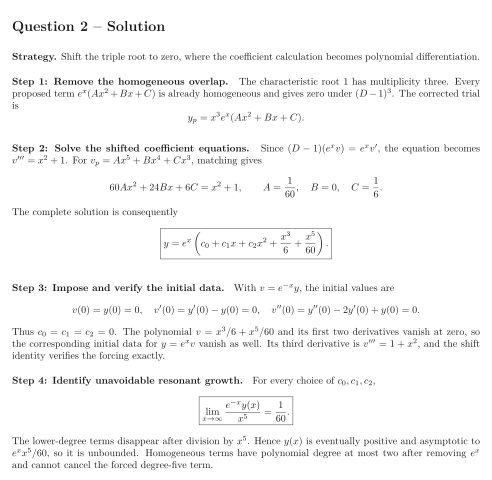
Question 2 – Solution
Strategy. Shift the triple root to zero, where the coefficient calculation becomes polynomial differentiation.
Step 1: Remove the homogeneous overlap. The characteristic root has multiplicity three. Every proposed term is already homogeneous and gives zero under . The corrected trial is
Step 2: Solve the shifted coefficient equations. Since , the equation becomes . For , matching gives The complete solution is consequently
Step 3: Impose and verify the initial data. With , the initial values are Thus . The polynomial and its first two derivatives vanish at zero, so the corresponding initial data for vanish as well. Its third derivative is , and the shift identity verifies the forcing exactly.
Step 4: Identify unavoidable resonant growth. For every choice of , The lower-degree terms disappear after division by . Hence is eventually positive and asymptotic to , so it is unbounded. Homogeneous terms have polynomial degree at most two after removing and cannot cancel the forced degree-five term.