Question 4
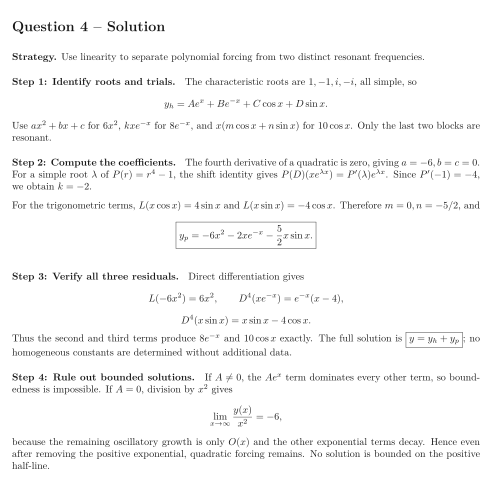
On , consider Its three forcing terms require different coefficient calculations.
Tasks
Factor the characteristic polynomial, write the full real homogeneous solution, and select a separate particular-solution trial for each forcing term.
Determine all coefficients and assemble one particular solution.
Verify each forcing contribution directly using , rather than relying only on the trial-selection rule. Write the complete general solution.
Decide whether any solution is bounded on . Prove your answer even when homogeneous constants are chosen to cancel all removable growing terms.
Show solutionHide solution
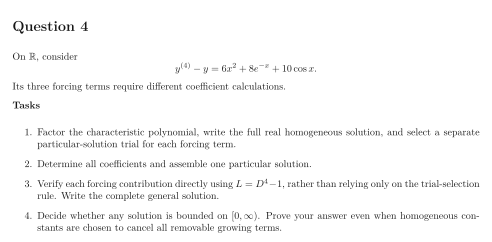
Question 4 – Solution
Strategy. Use linearity to separate polynomial forcing from two distinct resonant frequencies.
Step 1: Identify roots and trials. The characteristic roots are , all simple, so Use for , for , and for . Only the last two blocks are resonant.
Step 2: Compute the coefficients. The fourth derivative of a quadratic is zero, giving . For a simple root of , the shift identity gives . Since , we obtain .
For the trigonometric terms, and . Therefore , and
Step 3: Verify all three residuals. Direct differentiation gives Thus the second and third terms produce and exactly. The full solution is ; no homogeneous constants are determined without additional data.
Step 4: Rule out bounded solutions. If , the term dominates every other term, so boundedness is impossible. If , division by gives because the remaining oscillatory growth is only and the other exponential terms decay. Hence even after removing the positive exponential, quadratic forcing remains. No solution is bounded on the positive half-line.