Question 7
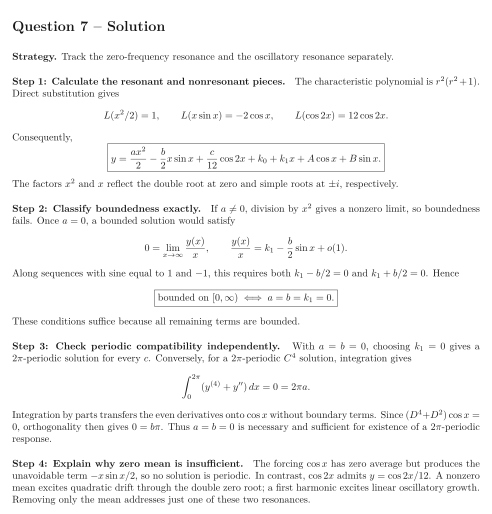
For real parameters , consider A forcing with zero average over a period need not admit a periodic response.
Tasks
Use undetermined coefficients to find a particular solution for all , and write the full real general solution.
Give necessary and sufficient conditions on the parameters and homogeneous constants for boundedness on .
Determine exactly when the equation admits a -periodic solution. Verify the necessary restrictions independently by integrating the equation against and over one period.
Give a forcing in this family with zero average but no periodic solution, and another nonzero forcing that does admit periodic solutions. Explain the different obstructions caused by a nonzero mean and by a resonant harmonic.
Show solutionHide solution
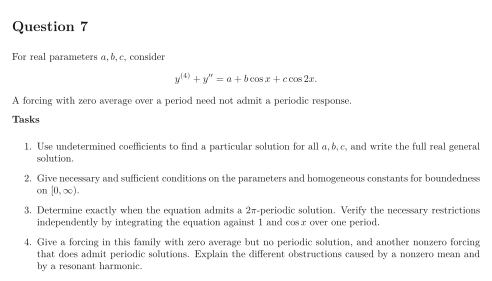
Question 7 – Solution
Strategy. Track the zero-frequency resonance and the oscillatory resonance separately.
Step 1: Calculate the resonant and nonresonant pieces. The characteristic polynomial is . Direct substitution gives Consequently, The factors and reflect the double root at zero and simple roots at , respectively.
Step 2: Classify boundedness exactly. If , division by gives a nonzero limit, so boundedness fails. Once , a bounded solution would satisfy Along sequences with sine equal to and , this requires both and . Hence These conditions suffice because all remaining terms are bounded.
Step 3: Check periodic compatibility independently. With , choosing gives a -periodic solution for every . Conversely, for a -periodic solution, integration gives Integration by parts transfers the even derivatives onto without boundary terms. Since , orthogonality then gives . Thus is necessary and sufficient for existence of a -periodic response.
Step 4: Explain why zero mean is insufficient. The forcing has zero average but produces the unavoidable term , so no solution is periodic. In contrast, admits . A nonzero mean excites quadratic drift through the double zero root; a first harmonic excites linear oscillatory growth. Removing only the mean addresses just one of these two resonances.