Question 10
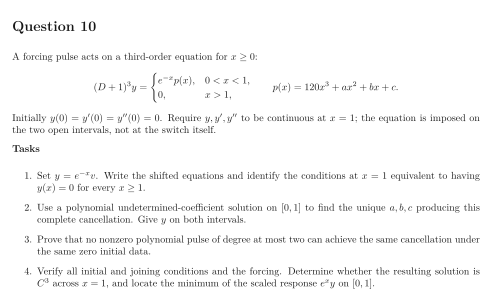
A forcing pulse acts on a third-order equation for : Initially . Require to be continuous at ; the equation is imposed on the two open intervals, not at the switch itself.
Tasks
Set . Write the shifted equations and identify the conditions at equivalent to having for every .
Use a polynomial undetermined-coefficient solution on to find the unique producing this complete cancellation. Give on both intervals.
Prove that no nonzero polynomial pulse of degree at most two can achieve the same cancellation under the same zero initial data.
Verify all initial and joining conditions and the forcing. Determine whether the resulting solution is across , and locate the minimum of the scaled response on .
Show solutionHide solution
Question 10 – Solution
Strategy. Convert the pulse into a polynomial third derivative and enforce triple zeros at both ends.
Step 1: Translate the initial and terminal states. The shift gives on and on . Multiplication by the smooth, nonzero preserves matching of the first three state components. Thus , and complete cancellation requires . These terminal conditions also suffice: the post-pulse quadratic solution is then zero.
Step 2: Determine the polynomial exactly. The zero-data polynomial solution of has degree six and leading coefficient , since . The three zero conditions at each endpoint require divisibility by . Equal degrees and leading coefficients therefore force Differentiating three times gives . Hence The formulas agree at the shared endpoint and uniquely determine the pulse.
Step 3: Prove the degree is necessary. For a polynomial of degree at most two, the zero-data solution has degree at most five. The terminal requirements would still make it divisible by the degree-six polynomial . It must therefore be zero, and so must . No nonzero lower-degree polynomial pulse works.
Step 4: Check the join and the scaled shape. The triple endpoint zeros verify all six state conditions. The computed third derivative verifies the forcing before the switch; the zero branch verifies it afterward. At , the left third derivative of is , while the right third derivative is zero. Thus is but not across the switch, exactly as allowed.
On , . Since has maximum at , the scaled response has its unique minimum there.
See the diagram in the original worksheet below.
