Question 7
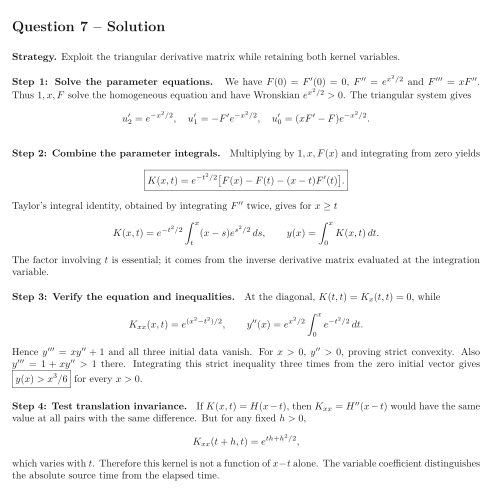
For the variable-coefficient IVP define and use the homogeneous basis .
Tasks
Verify the basis and its Wronskian, then derive the three variation-parameter derivatives.
Combine the lower-limit-zero parameter integrals into . Write both using and as a definite integral for .
Differentiate to verify the IVP. Prove that is strictly convex and for every .
Determine whether can depend only on . Use a derivative of the kernel to give a precise obstruction to treating this variable-coefficient response as a translation-invariant convolution.
Show solutionHide solution
Question 7 – Solution
Strategy. Exploit the triangular derivative matrix while retaining both kernel variables.
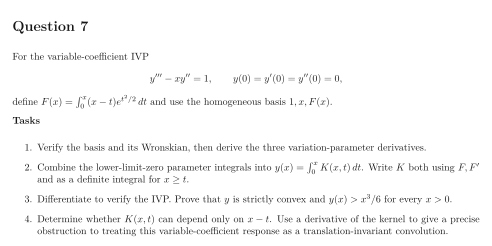
Step 1: Solve the parameter equations. We have , and . Thus solve the homogeneous equation and have Wronskian . The triangular system gives
Step 2: Combine the parameter integrals. Multiplying by and integrating from zero yields Taylor’s integral identity, obtained by integrating twice, gives for The factor involving is essential; it comes from the inverse derivative matrix evaluated at the integration variable.
Step 3: Verify the equation and inequalities. At the diagonal, , while Hence and all three initial data vanish. For , , proving strict convexity. Also there. Integrating this strict inequality three times from the zero initial vector gives for every .
Step 4: Test translation invariance. If , then would have the same value at all pairs with the same difference. But for any fixed , which varies with . Therefore this kernel is not a function of alone. The variable coefficient distinguishes the absolute source time from the elapsed time.