Question 9
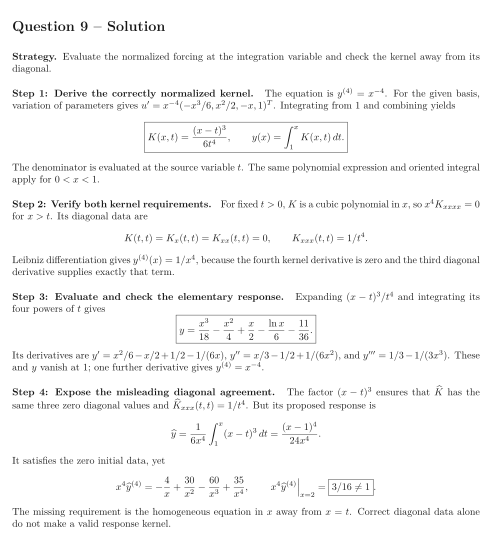
On , consider A proposed response kernel for is The placement of the leading-coefficient factor must be checked, not guessed.
Tasks
Normalize the equation and derive the correct kernel from variation of parameters using .
For fixed , verify the correct kernel’s homogeneous equation when and its first four diagonal data, through the third -derivative.
Integrate the correct kernel from to to find the IVP solution in elementary form. Verify its initial data and forcing.
Show that has the same diagonal data but is still wrong. Compute the response it would predict and evaluate at . Explain which additional kernel requirement fails.
Show solutionHide solution
Question 9 – Solution
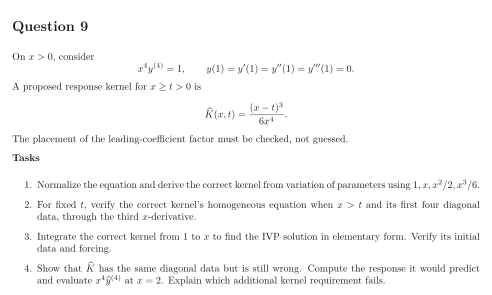
Strategy. Evaluate the normalized forcing at the integration variable and check the kernel away from its diagonal.
Step 1: Derive the correctly normalized kernel. The equation is . For the given basis, variation of parameters gives . Integrating from and combining yields The denominator is evaluated at the source variable . The same polynomial expression and oriented integral apply for .
Step 2: Verify both kernel requirements. For fixed , is a cubic polynomial in , so for . Its diagonal data are Leibniz differentiation gives , because the fourth kernel derivative is zero and the third diagonal derivative supplies exactly that term.
Step 3: Evaluate and check the elementary response. Expanding and integrating its four powers of gives Its derivatives are , , and . These and vanish at ; one further derivative gives .
Step 4: Expose the misleading diagonal agreement. The factor ensures that has the same three zero diagonal values and . But its proposed response is It satisfies the zero initial data, yet The missing requirement is the homogeneous equation in away from . Correct diagonal data alone do not make a valid response kernel.