Question 2
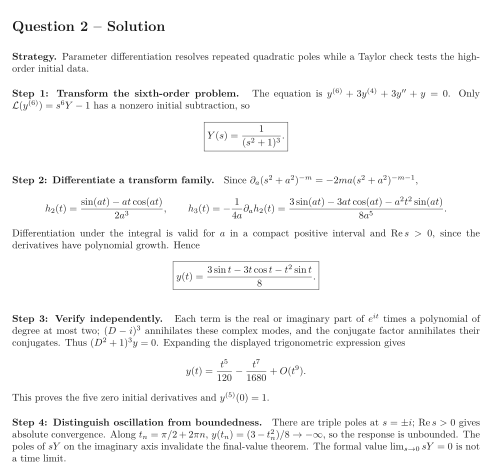
A sixth-order initial-value problem is where and . To invert a repeated quadratic pole, introduce for .
Tasks
Expand the differential operator and transform the problem. Explain why only one initial term survives.
Starting with , use differentiation with respect to twice to invert . Then set .
Verify the equation and initial state without relying on the transform calculation. Identify the first nonzero Taylor term.
Describe the pole multiplicities and a convergence half-plane. Decide whether the solution is bounded and whether the final-value theorem can be used, giving a decisive argument for each claim.
Show solutionHide solution
Question 2 – Solution
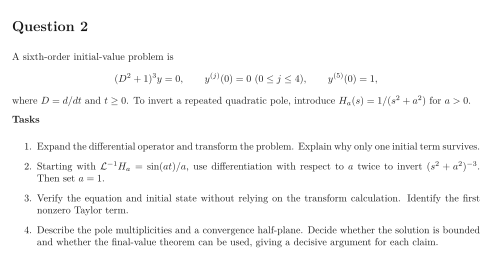
Strategy. Parameter differentiation resolves repeated quadratic poles while a Taylor check tests the high-order initial data.
Step 1: Transform the sixth-order problem. The equation is . Only has a nonzero initial subtraction, so
Step 2: Differentiate a transform family. Since , Differentiation under the integral is valid for in a compact positive interval and , since the derivatives have polynomial growth. Hence
Step 3: Verify independently. Each term is the real or imaginary part of times a polynomial of degree at most two; annihilates these complex modes, and the conjugate factor annihilates their conjugates. Thus . Expanding the displayed trigonometric expression gives This proves the five zero initial derivatives and .
Step 4: Distinguish oscillation from boundedness. There are triple poles at ; gives absolute convergence. Along , , so the response is unbounded. The poles of on the imaginary axis invalidate the final-value theorem. The formal value is not a time limit.