Question 4
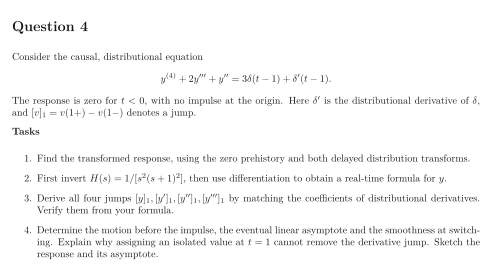
Consider the causal, distributional equation The response is zero for , with no impulse at the origin. Here is the distributional derivative of , and denotes a jump.
Tasks
Find the transformed response, using the zero prehistory and both delayed distribution transforms.
First invert , then use differentiation to obtain a real-time formula for .
Derive all four jumps by matching the coefficients of distributional derivatives. Verify them from your formula.
Determine the motion before the impulse, the eventual linear asymptote and the smoothness at switching. Explain why assigning an isolated value at cannot remove the derivative jump. Sketch the response and its asymptote.
Show solutionHide solution
Question 4 – Solution
Strategy. Separate the impulse kernel from the input derivative, then match distributions rather than imposing false continuity conditions.
Step 1: Transform the distributions. For positive delay, and . Zero prehistory therefore gives
Step 2: Invert the kernel. Since , and . Thus transforms , without an additional origin impulse. For ,
Step 3: Match every singular coefficient. Put . The coefficients of in the left side are, respectively, Matching gives . Directly, ; away from , , completing the distributional verification.
Step 4: Interpret the motion. The response vanishes before and approaches afterward. It is , but its one-sided second derivatives differ. Changing a function at one point cannot change those one-sided limits or its distribution.
See the diagram in the original worksheet below.
