Question 2
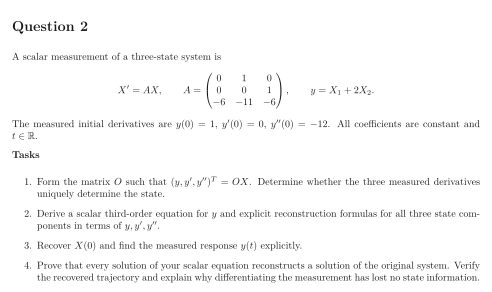
A scalar measurement of a three-state system is The measured initial derivatives are , , . All coefficients are constant and .
Tasks
Form the matrix such that . Determine whether the three measured derivatives uniquely determine the state.
Derive a scalar third-order equation for and explicit reconstruction formulas for all three state components in terms of .
Recover and find the measured response explicitly.
Prove that every solution of your scalar equation reconstructs a solution of the original system. Verify the recovered trajectory and explain why differentiating the measurement has lost no state information.
Show solutionHide solution
Question 2 – Solution
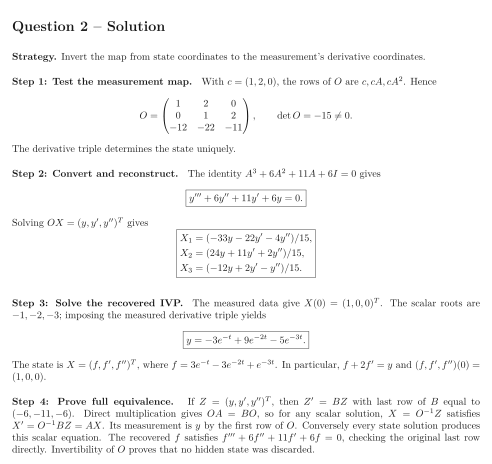
Strategy. Invert the map from state coordinates to the measurement’s derivative coordinates.
Step 1: Test the measurement map. With , the rows of are . Hence The derivative triple determines the state uniquely.
Step 2: Convert and reconstruct. The identity gives Solving gives
Step 3: Solve the recovered IVP. The measured data give . The scalar roots are ; imposing the measured derivative triple yields The state is , where . In particular, and .
Step 4: Prove full equivalence. If , then with last row of equal to . Direct multiplication gives , so for any scalar solution, satisfies . Its measurement is by the first row of . Conversely every state solution produces this scalar equation. The recovered satisfies , checking the original last row directly. Invertibility of proves that no hidden state was discarded.