Question 4
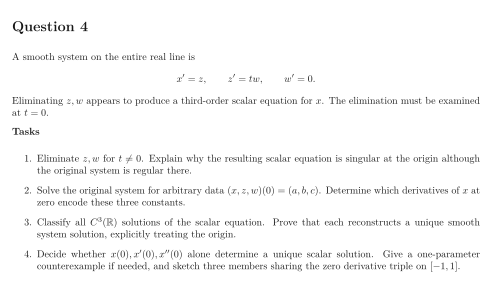
A smooth system on the entire real line is Eliminating appears to produce a third-order scalar equation for . The elimination must be examined at .
Tasks
Eliminate for . Explain why the resulting scalar equation is singular at the origin although the original system is regular there.
Solve the original system for arbitrary data . Determine which derivatives of at zero encode these three constants.
Classify all solutions of the scalar equation. Prove that each reconstructs a unique smooth system solution, explicitly treating the origin.
Decide whether alone determine a unique scalar solution. Give a one-parameter counterexample if needed, and sketch three members sharing the zero derivative triple on .
Show solutionHide solution
Question 4 – Solution
Strategy. Retain the state coordinate that division by conceals at the singular point.
Step 1: Eliminate on the regular subintervals. Since , for we have . Differentiating gives The leading coefficient vanishes at zero. This singularity came from the chosen scalar coordinate; the original system matrix is continuous everywhere.
Step 2: Solve before dividing. Integrating successively gives Thus , while . The missing state coordinate is encoded in the third derivative, not in the usual second derivative.
Step 3: Check global equivalence. On either side of zero, , so . Continuity of matches , and continuity of matches . All solutions therefore have the single global polynomial form above. Reconstruct and off zero, setting . These are smooth and satisfy all three system equations. At zero, the scalar equation itself requires .
Step 4: Explain the apparent nonuniqueness. The family has for every . It corresponds to distinct system data , so it does not contradict uniqueness for the regular system. The plotted members use .
See the diagram in the original worksheet below.
