Question 6
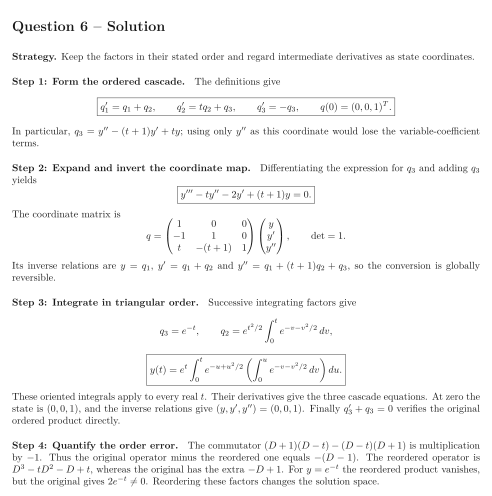
Let . Ordered differential factors act from right to left in Here . Multiplication by does not commute with differentiation.
Tasks
Define , , . Derive the first-order system for and its initial vector.
Expand the scalar third-order equation and show that the change between and is invertible for every real .
Solve the triangular system by successive integrating factors. Give an explicit nested-integral formula for and verify the initial data and equation through the state relations.
Compare the given operator with . Compute their difference, and exhibit a function that solves the reordered equation but not the original one.
Show solutionHide solution
Question 6 – Solution
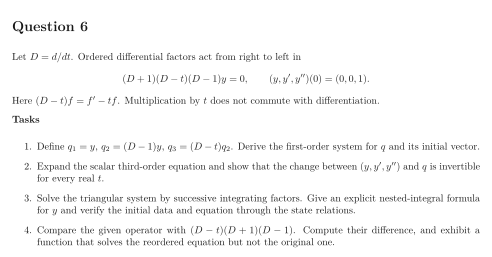
Strategy. Keep the factors in their stated order and regard intermediate derivatives as state coordinates.
Step 1: Form the ordered cascade. The definitions give In particular, ; using only as this coordinate would lose the variable-coefficient terms.
Step 2: Expand and invert the coordinate map. Differentiating the expression for and adding yields The coordinate matrix is Its inverse relations are , and , so the conversion is globally reversible.
Step 3: Integrate in triangular order. Successive integrating factors give These oriented integrals apply to every real . Their derivatives give the three cascade equations. At zero the state is , and the inverse relations give . Finally verifies the original ordered product directly.
Step 4: Quantify the order error. The commutator is multiplication by . Thus the original operator minus the reordered one equals . The reordered operator is , whereas the original has the extra . For the reordered product vanishes, but the original gives . Reordering these factors changes the solution space.