Question 10
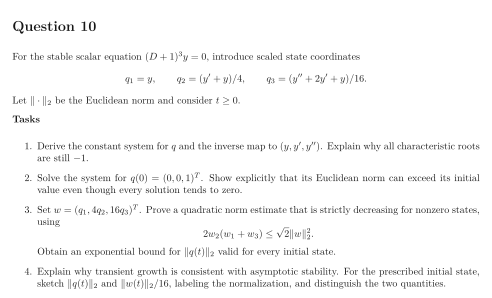
For the stable scalar equation , introduce scaled state coordinates Let be the Euclidean norm and consider .
Tasks
Derive the constant system for and the inverse map to . Explain why all characteristic roots are still .
Solve the system for . Show explicitly that its Euclidean norm can exceed its initial value even though every solution tends to zero.
Set . Prove a quadratic norm estimate that is strictly decreasing for nonzero states, using Obtain an exponential bound for valid for every initial state.
Explain why transient growth is consistent with asymptotic stability. For the prescribed initial state, sketch and , labeling the normalization, and distinguish the two quantities.
Show solutionHide solution
Question 10 – Solution
Strategy. Compare Euclidean growth in scaled coordinates with decay in a suitable weighted norm.
Step 1: Derive the scaled cascade. With having ones just above the diagonal, The coordinate map is invertible, so this is a similarity transformation of the scalar companion system. Its triangular matrix has three eigenvalues .
Step 2: Compute an actual transient. Since , . Therefore The initial norm is one, but . Every state still tends to zero because its components are polynomials times .
Step 3: Prove a uniform weighted estimate. The new state satisfies , so The stated inequality follows from Cauchy–Schwarz and . With , integration and give
Step 4: Interpret coordinate-dependent growth. Asymptotic stability allows a finite transient; it does not require every norm to decrease at every instant. For this trajectory, decreases strictly, whereas has a pronounced transient. They measure the same state with different weights.
See the diagram in the original worksheet below.
