Question 10
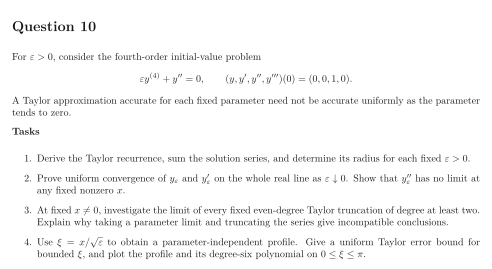
For , consider the fourth-order initial-value problem A Taylor approximation accurate for each fixed parameter need not be accurate uniformly as the parameter tends to zero.
Tasks
Derive the Taylor recurrence, sum the solution series, and determine its radius for each fixed .
Prove uniform convergence of and on the whole real line as . Show that has no limit at any fixed nonzero .
At fixed , investigate the limit of every fixed even-degree Taylor truncation of degree at least two. Explain why taking a parameter limit and truncating the series give incompatible conclusions.
Use to obtain a parameter-independent profile. Give a uniform Taylor error bound for bounded , and plot the profile and its degree-six polynomial on .
Show solutionHide solution
Question 10 – Solution
Strategy. Resolve the shrinking oscillation scale before judging a series truncation.
Step 1: Derive and sum the series. The recurrence is , with , . Therefore The radius is infinite for each fixed positive parameter. The formula verifies all four initial derivatives and the equation directly.
Step 2: Distinguish levels of derivative convergence. The bounds and prove uniform convergence to zero on . But . For fixed , the sequences and give values and . No pointwise limit exists there. The reduced equation cannot retain the original second-derivative datum.
Step 3: Test fixed truncations. The degree-two polynomial is , which fails to approach zero at fixed nonzero . For any fixed degree , its highest term is a nonzero constant times and dominates the lower powers as . Thus the truncation diverges while the full sum tends to zero. The Taylor remainder is not uniform in this parameter at fixed .
Step 4: Rescale and certify. With , Taylor’s theorem gives, for , Multiplying by bounds the original displacement error. For the graph, , , so the profile error is at most .
See the diagram in the original worksheet below.
