Question 7
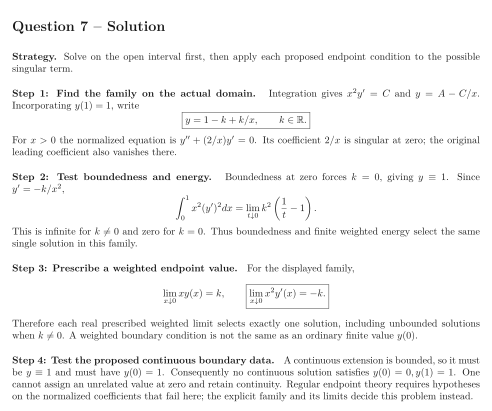
Consider a singular-endpoint problem on : An additional condition at zero is to be imposed through a limit or regularity requirement. The differential equation is initially required only for .
Tasks
Find every solution on satisfying the right boundary condition. Identify why zero is not a regular endpoint of the normalized equation.
Select the solutions that remain bounded as , and separately those with finite weighted energy . Determine whether these two selections agree.
Replace boundedness by , with prescribed. Find the unique solution for every real and its limiting weighted derivative .
Decide whether a continuous solution can satisfy and . Explain why two stated endpoint values do not justify invoking the usual regular boundary-value theory at this singular endpoint.
Show solutionHide solution
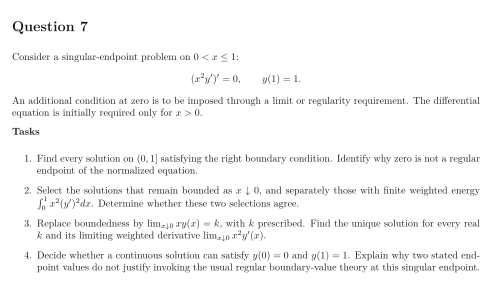
Question 7 – Solution
Strategy. Solve on the open interval first, then apply each proposed endpoint condition to the possible singular term.
Step 1: Find the family on the actual domain. Integration gives and . Incorporating , write For the normalized equation is . Its coefficient is singular at zero; the original leading coefficient also vanishes there.
Step 2: Test boundedness and energy. Boundedness at zero forces , giving . Since , This is infinite for and zero for . Thus boundedness and finite weighted energy select the same single solution in this family.
Step 3: Prescribe a weighted endpoint value. For the displayed family, Therefore each real prescribed weighted limit selects exactly one solution, including unbounded solutions when . A weighted boundary condition is not the same as an ordinary finite value .
Step 4: Test the proposed continuous boundary data. A continuous extension is bounded, so it must be and must have . Consequently no continuous solution satisfies . One cannot assign an unrelated value at zero and retain continuity. Regular endpoint theory requires hypotheses on the normalized coefficients that fail here; the explicit family and its limits decide this problem instead.