Question 2
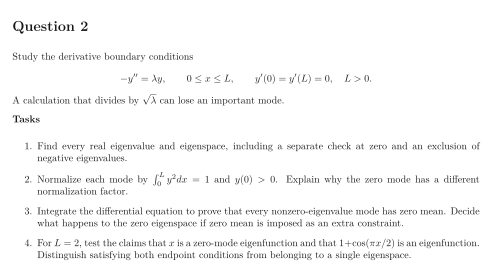
Study the derivative boundary conditions A calculation that divides by can lose an important mode.
Tasks
Find every real eigenvalue and eigenspace, including a separate check at zero and an exclusion of negative eigenvalues.
Normalize each mode by and . Explain why the zero mode has a different normalization factor.
Integrate the differential equation to prove that every nonzero-eigenvalue mode has zero mean. Decide what happens to the zero eigenspace if zero mean is imposed as an extra constraint.
For , test the claims that is a zero-mode eigenfunction and that is an eigenfunction. Distinguish satisfying both endpoint conditions from belonging to a single eigenspace.
Show solutionHide solution
Question 2 – Solution
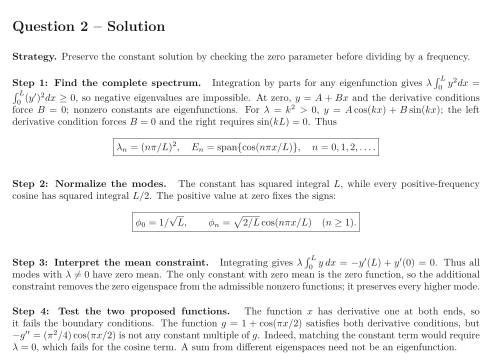
Strategy. Preserve the constant solution by checking the zero parameter before dividing by a frequency.
Step 1: Find the complete spectrum. Integration by parts for any eigenfunction gives , so negative eigenvalues are impossible. At zero, and the derivative conditions force ; nonzero constants are eigenfunctions. For , ; the left derivative condition forces and the right requires . Thus
Step 2: Normalize the modes. The constant has squared integral , while every positive-frequency cosine has squared integral . The positive value at zero fixes the signs:
Step 3: Interpret the mean constraint. Integrating gives . Thus all modes with have zero mean. The only constant with zero mean is the zero function, so the additional constraint removes the zero eigenspace from the admissible nonzero functions; it preserves every higher mode.
Step 4: Test the two proposed functions. The function has derivative one at both ends, so it fails the boundary conditions. The function satisfies both derivative conditions, but is not any constant multiple of . Indeed, matching the constant term would require , which fails for the cosine term. A sum from different eigenspaces need not be an eigenfunction.