Question 8
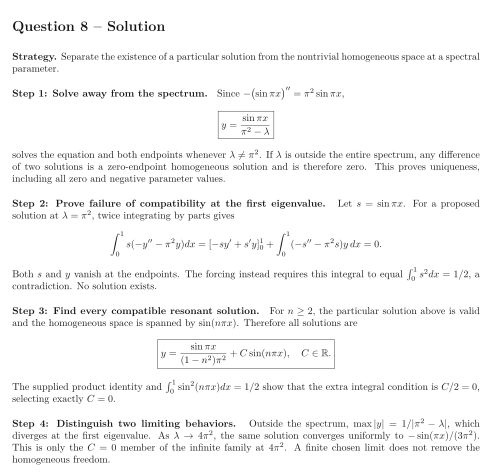
Compare an eigenproblem with its forced counterpart on : The homogeneous Dirichlet eigenvalues of are , . The identity may be verified by .
Tasks
Solve the forced problem for every real outside the homogeneous spectrum and prove uniqueness.
At , prove nonexistence using integration by parts against , rather than merely observing a vanishing denominator.
At with , find all solutions. Determine which is selected by .
Compare the uniform size of the solution as with its limit as through nonspectral values. Explain why a finite limiting particular solution does not imply uniqueness at the limiting parameter.
Show solutionHide solution
Question 8 – Solution
Strategy. Separate the existence of a particular solution from the nontrivial homogeneous space at a spectral parameter.
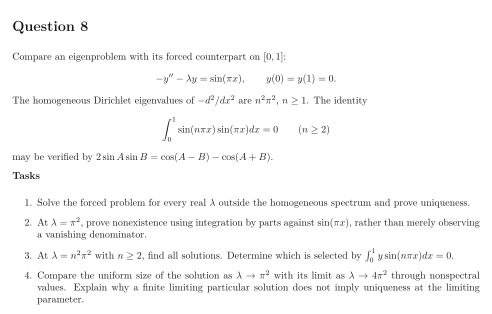
Step 1: Solve away from the spectrum. Since , solves the equation and both endpoints whenever . If is outside the entire spectrum, any difference of two solutions is a zero-endpoint homogeneous solution and is therefore zero. This proves uniqueness, including all zero and negative parameter values.
Step 2: Prove failure of compatibility at the first eigenvalue. Let . For a proposed solution at , twice integrating by parts gives Both and vanish at the endpoints. The forcing instead requires this integral to equal , a contradiction. No solution exists.
Step 3: Find every compatible resonant solution. For , the particular solution above is valid and the homogeneous space is spanned by . Therefore all solutions are The supplied product identity and show that the extra integral condition is , selecting exactly .
Step 4: Distinguish two limiting behaviors. Outside the spectrum, , which diverges at the first eigenvalue. As , the same solution converges uniformly to . This is only the member of the infinite family at . A finite chosen limit does not remove the homogeneous freedom.