Question 10
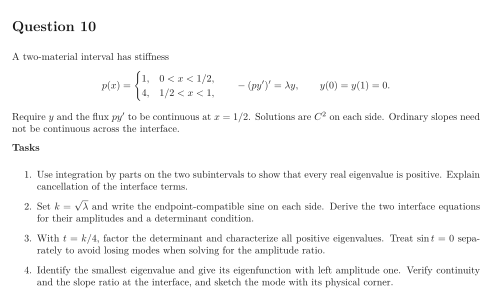
A two-material interval has stiffness Require and the flux to be continuous at . Solutions are on each side. Ordinary slopes need not be continuous across the interface.
Tasks
Use integration by parts on the two subintervals to show that every real eigenvalue is positive. Explain cancellation of the interface terms.
Set and write the endpoint-compatible sine on each side. Derive the two interface equations for their amplitudes and a determinant condition.
With , factor the determinant and characterize all positive eigenvalues. Treat separately to avoid losing modes when solving for the amplitude ratio.
Identify the smallest eigenvalue and give its eigenfunction with left amplitude one. Verify continuity and the slope ratio at the interface, and sketch the mode with its physical corner.
Show solutionHide solution
Question 10 – Solution
Strategy. Match displacement and stiffness-weighted slope, then preserve every branch of the determinant equation.
Step 1: Exclude nonpositive eigenvalues. Adding the two integrations by parts gives : endpoint values vanish and the interface terms cancel because both and match. The right side is positive for a nonzero admissible function; equality would make it constant on both sides, hence identically zero. Therefore .
Step 2: Form the interface system. The endpoint-compatible pieces are on the left and on the right. With , matching gives The second equation uses flux, not ordinary derivative. The determinant vanishes exactly when .
Step 3: Preserve both spectral branches. Factoring yields . Thus the complete spectrum is At , the first matching equation is zero and the second gives . On the other branch, and . Each branch gives a nonzero solution and a one-dimensional eigenspace. The apparent root is excluded by Step 1.
Step 4: Construct the first mode and its corner. The smallest positive root is . Hence and, taking , At the join both values equal . The one-sided slopes are and , so as required by flux continuity. The slope change is physical; smoothing it would violate the model.
See the diagram in the original worksheet below.
