Question 1
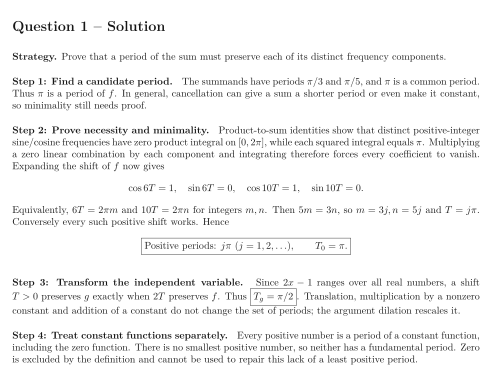
A positive number is a period of if for every real . A fundamental period is the smallest positive period, when one exists. Consider You may use linear independence of sines and cosines at distinct positive integer frequencies; justify that fact here by integrating products on .
Tasks
Find a common period of the two summands. Explain why a common period alone does not prove that the sum has that fundamental period.
Expand and use independence to characterize every positive period of . Determine the fundamental period exactly.
Find the fundamental period of . Explain the effects of translation, nonzero amplitude scaling and a constant offset.
Decide whether a nonzero constant function and the zero function have fundamental periods. Explain why the definition cannot simply assign either function period zero as a fundamental period.
Show solutionHide solution
Question 1 – Solution
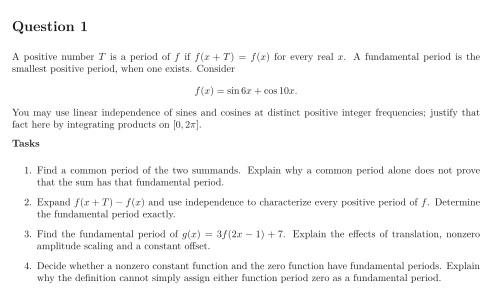
Strategy. Prove that a period of the sum must preserve each of its distinct frequency components.
Step 1: Find a candidate period. The summands have periods and , and is a common period. Thus is a period of . In general, cancellation can give a sum a shorter period or even make it constant, so minimality still needs proof.
Step 2: Prove necessity and minimality. Product-to-sum identities show that distinct positive-integer sine/cosine frequencies have zero product integral on , while each squared integral equals . Multiplying a zero linear combination by each component and integrating therefore forces every coefficient to vanish. Expanding the shift of now gives Equivalently, and for integers . Then , so and . Conversely every such positive shift works. Hence
Step 3: Transform the independent variable. Since ranges over all real numbers, a shift preserves exactly when preserves . Thus . Translation, multiplication by a nonzero constant and addition of a constant do not change the set of periods; the argument dilation rescales it.
Step 4: Treat constant functions separately. Every positive number is a period of a constant function, including the zero function. There is no smallest positive number, so neither has a fundamental period. Zero is excluded by the definition and cannot be used to repair this lack of a least positive period.