Question 5
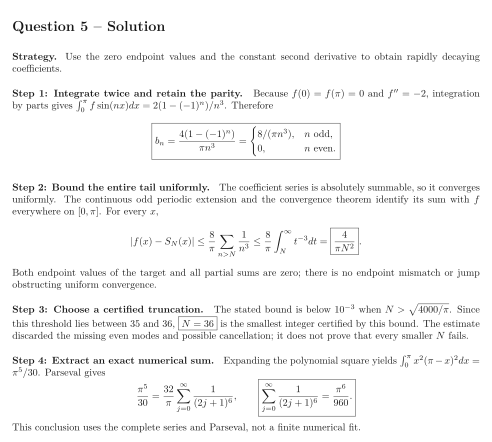
Let on and . You may use Parseval’s identity , and the standard convergence theorem for piecewise smooth odd periodic extensions.
Tasks
Derive all coefficients by integration by parts, and identify the missing modes.
Prove a uniform tail bound for . State why uniform convergence includes both endpoints here.
Find the smallest integer certified by that bound to give error below . Distinguish a sufficient certificate from the actual smallest successful truncation.
Evaluate exactly and use Parseval to derive the sum of the reciprocal sixth powers of the positive odd integers.
Show solutionHide solution
Question 5 – Solution
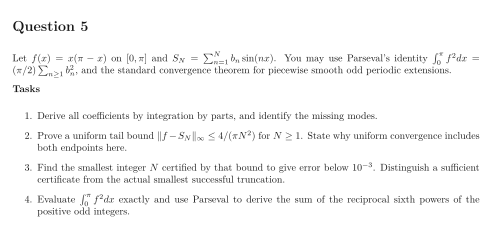
Strategy. Use the zero endpoint values and the constant second derivative to obtain rapidly decaying coefficients.
Step 1: Integrate twice and retain the parity. Because and , integration by parts gives . Therefore
Step 2: Bound the entire tail uniformly. The coefficient series is absolutely summable, so it converges uniformly. The continuous odd periodic extension and the convergence theorem identify its sum with everywhere on . For every , Both endpoint values of the target and all partial sums are zero; there is no endpoint mismatch or jump obstructing uniform convergence.
Step 3: Choose a certified truncation. The stated bound is below when . Since this threshold lies between 35 and 36, is the smallest integer certified by this bound. The estimate discarded the missing even modes and possible cancellation; it does not prove that every smaller fails.
Step 4: Extract an exact numerical sum. Expanding the polynomial square yields . Parseval gives This conclusion uses the complete series and Parseval, not a finite numerical fit.