Question 2
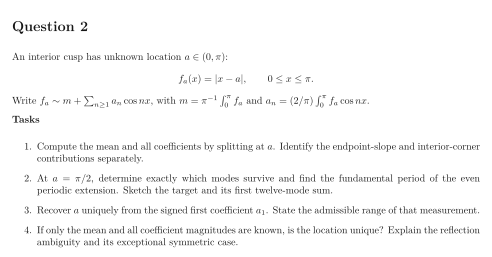
An interior cusp has unknown location : Write , with and .
Tasks
Compute the mean and all coefficients by splitting at . Identify the endpoint-slope and interior-corner contributions separately.
At , determine exactly which modes survive and find the fundamental period of the even periodic extension. Sketch the target and its first twelve-mode sum.
Recover uniquely from the signed first coefficient . State the admissible range of that measurement.
If only the mean and all coefficient magnitudes are known, is the location unique? Explain the reflection ambiguity and its exceptional symmetric case.
Show solutionHide solution
Question 2 – Solution
Strategy. Retain the interior slope jump when integrating a continuous function with a corner.
Step 1: Integrate the linear pieces. The triangular areas give . Twice integrating the pieces separately gives The endpoint slopes contribute , and the interior slope jump two contributes . None of these terms can be dropped.
Step 2: Specialize to the midpoint cusp. At the mean is . Odd modes vanish, and among the even modes exactly survive, with coefficient . The extension has period ; its maxima occur precisely at multiples of , so every positive period must be a positive multiple of . Its fundamental period is therefore . Absolute coefficient summability gives uniform convergence, and the continuous piecewise linear even extension identifies the sum at all points, including cusps.
Step 3: Invert the first coefficient. The general formula gives . Strict monotonicity of cosine on yields The open measurement range corresponds exactly to interior cusp locations.
Step 4: Describe what magnitudes lose. Reflection gives and , with unchanged mean. Thus all magnitudes coincide for and . In fact , so the mean leaves precisely those two possibilities unless , when they coincide. Signed odd coefficients resolve the nonsymmetric ambiguity.
See the diagram in the original worksheet below.
