Question 1
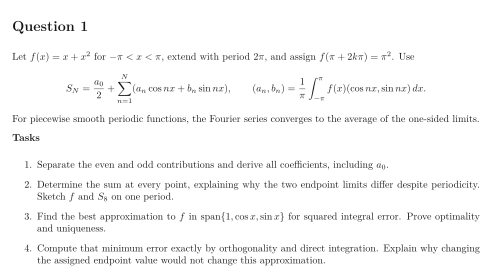
Let for , extend with period , and assign . Use For piecewise smooth periodic functions, the Fourier series converges to the average of the one-sided limits.
Tasks
Separate the even and odd contributions and derive all coefficients, including .
Determine the sum at every point, explaining why the two endpoint limits differ despite periodicity. Sketch and on one period.
Find the best approximation to in for squared integral error. Prove optimality and uniqueness.
Compute that minimum error exactly by orthogonality and direct integration. Explain why changing the assigned endpoint value would not change this approximation.
Show solutionHide solution
Question 1 – Solution
Strategy. Use parity to separate coefficients, then use orthogonal projection to measure the combined approximation.
Step 1: Separate the two symmetries. The even part is and the odd part is . Odd integrands give zero in the cross terms. Integration by parts gives For example, and .
Step 2: Identify the periodic join. Inside the base interval the sum is . At the join, the left limit is and the right limit is , so the sum is . Periodicity identifies the location of the join, not its two one-sided limits. The assigned value equals this average; the target still has a jump.
Step 3: Prove the projection claim. Orthogonality gives The residual is orthogonal to the three basis functions. For any other , Thus is the unique minimizer in this span.
Step 4: Compute the error independently. The odd cross term integrates to zero, giving , while . Consequently Changing isolated endpoint values changes neither integrals nor coefficients. It may change whether the assigned values equal the series sums.
See the diagram in the original worksheet below.
