Question 8
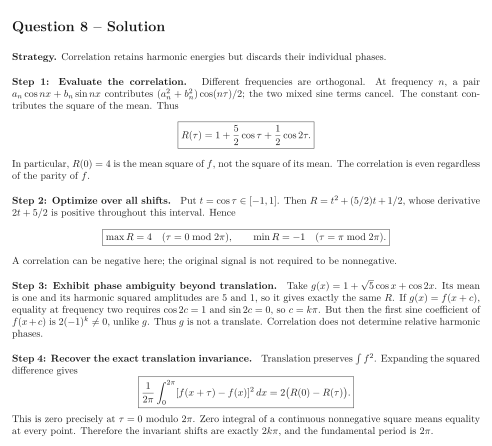
Let . Its periodic autocorrelation is
Tasks
Derive using orthogonality. Explain why sine terms disappear from the correlation even though has a nonzero sine coefficient.
Find the exact maximum and minimum of , including all shifts attaining them modulo .
Construct a real trigonometric polynomial with the same mean and the same which is not a translate of . Prove both claims.
Derive the identity relating to the squared distance between and its translate. Determine every shift leaving unchanged and connect this with the fundamental period.
Show solutionHide solution
Question 8 – Solution
Strategy. Correlation retains harmonic energies but discards their individual phases.
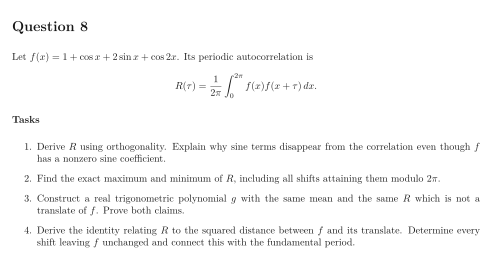
Step 1: Evaluate the correlation. Different frequencies are orthogonal. At frequency , a pair contributes ; the two mixed sine terms cancel. The constant contributes the square of the mean. Thus In particular, is the mean square of , not the square of its mean. The correlation is even regardless of the parity of .
Step 2: Optimize over all shifts. Put . Then , whose derivative is positive throughout this interval. Hence A correlation can be negative here; the original signal is not required to be nonnegative.
Step 3: Exhibit phase ambiguity beyond translation. Take . Its mean is one and its harmonic squared amplitudes are and , so it gives exactly the same . If , equality at frequency two requires and , so . But then the first sine coefficient of is , unlike . Thus is not a translate. Correlation does not determine relative harmonic phases.
Step 4: Recover the exact translation invariance. Translation preserves . Expanding the squared difference gives This is zero precisely at modulo . Zero integral of a continuous nonnegative square means equality at every point. Therefore the invariant shifts are exactly , and the fundamental period is .