Question 10
Two periodic signals are and . To align them by one delay, minimize
Tasks
Use orthogonality to derive without expanding a long pointwise square.
Determine all globally optimal delays and the exact minimum error. Prove global optimality.
Compare delays and . Explain why exactly aligning the first harmonic need not give the best alignment of the full signal.
Decide whether any delay makes the two functions identical. Sketch over one period, marking every minimizer, and explain the nonuniqueness of the best delay.
Show solutionHide solution
Question 10 – Solution
Strategy. One delay rotates each harmonic by a different multiple of the same angle, creating a coupled optimization.
Step 1: Compute distance through correlation. Both signals have squared norm . Angle addition and orthogonality give Therefore The sine sign follows from .
Step 2: Optimize over the whole circle. Put . Since , The feasible value is the unique minimizing sine value. Consequently Completing the square proves these are all global minimizers.
Step 3: Compare two tempting alignments. At , the second harmonics agree and . At , the first harmonic matches , but the second becomes , so . Exactly matching one harmonic can worsen the full error. The optimum balances their contributions and improves on both choices.
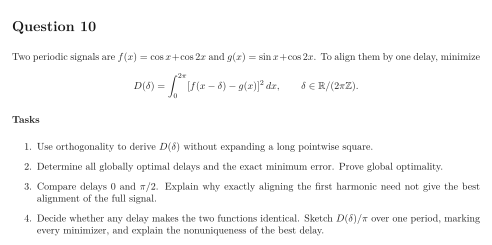
Step 4: Interpret the two minima. The minimum is strictly positive, so no delay makes the signals identical. The objective depends only on ; the two distinct delays with sine give the same compromise. They do not produce the same shifted function: their first cosine coefficients are opposite and nonzero. Thus nonuniqueness of the best delay does not imply exact agreement or identical aligned waveforms. The graph shows both minima in .
See the diagram in the original worksheet below.