Question 3
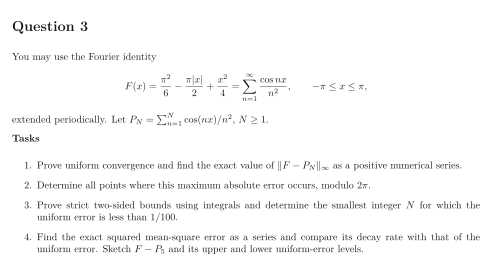
You may use the Fourier identity extended periodically. Let , .
Tasks
Prove uniform convergence and find the exact value of as a positive numerical series.
Determine all points where this maximum absolute error occurs, modulo .
Prove strict two-sided bounds using integrals and determine the smallest integer for which the uniform error is less than .
Find the exact squared mean-square error as a series and compare its decay rate with that of the uniform error. Sketch and its upper and lower uniform-error levels.
Show solutionHide solution
Question 3 – Solution
Strategy. Positive coefficients make the usual triangle bound attain its value at a common phase.
Step 1: Turn the tail estimate into an equality. The Weierstrass test applies because . Put . For every , , while at every cosine equals one. Hence This is an exact error, not merely a sufficient upper bound.
Step 2: Identify every equality point. For the tail to equal , every positive summand must have . Using two consecutive integers forces modulo . For the tail to equal , every would have to be . But then for a frequency also in the tail, a contradiction. Thus the maximum absolute error occurs exactly at modulo .
Step 3: Certify the minimal truncation. Strict monotonicity of gives At , . At , ; monotonicity excludes every smaller . Therefore the exact smallest choice is . The two integral bounds straddle the threshold tightly enough to decide it.
Step 4: Compare the two norms. Orthogonality gives The uniform error is of order , whereas the error is of order (its square is of order ). Distinguish the norm from its square.
See the diagram in the original worksheet below.
