Question 6
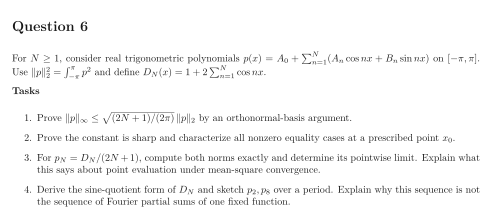
For , consider real trigonometric polynomials on . Use and define .
Tasks
Prove by an orthonormal-basis argument.
Prove the constant is sharp and characterize all nonzero equality cases at a prescribed point .
For , compute both norms exactly and determine its pointwise limit. Explain what this says about point evaluation under mean-square convergence.
Derive the sine-quotient form of and sketch over a period. Explain why this sequence is not the sequence of Fourier partial sums of one fixed function.
Show solutionHide solution
Question 6 – Solution
Strategy. Point evaluation on a finite-dimensional space has a norm that grows with the number of available modes.
Step 1: Apply Cauchy–Schwarz in coefficient space. An orthonormal basis is , , . The sum of their squared values at any point is Cauchy–Schwarz against the orthonormal coefficient vector proves
Step 2: Identify equality cases. Equality at holds exactly when the coefficient vector is a real nonzero multiple of the basis-value vector at . Equivalently, This exhibits the sharp constant, not merely an upper estimate.
Step 3: Build a vanishing-energy sequence with a fixed peak. The triangle inequality and the value at zero give . Orthogonality gives . Consequently At modulo , . At every other fixed point it tends to zero by the quotient below. Point evaluation is therefore not continuous in the norm on the union of these polynomial spaces.
Step 4: Explain the oscillatory peak. Summing yields The removable value at zero is . The normalized peak narrows with . These cannot be successive partial sums of one fixed function: their constant coefficients change with , whereas truncation preserves every already-included Fourier coefficient.
See the diagram in the original worksheet below.
