Question 8
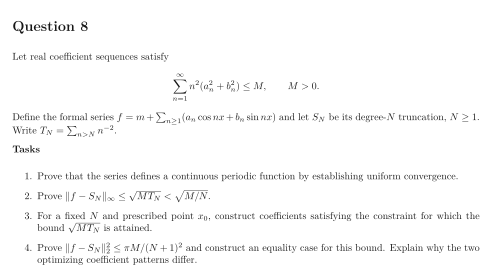
Let real coefficient sequences satisfy Define the formal series and let be its degree- truncation, . Write .
Tasks
Prove that the series defines a continuous periodic function by establishing uniform convergence.
Prove .
For a fixed and prescribed point , construct coefficients satisfying the constraint for which the bound is attained.
Prove and construct an equality case for this bound. Explain why the two optimizing coefficient patterns differ.
Show solutionHide solution
Question 8 – Solution
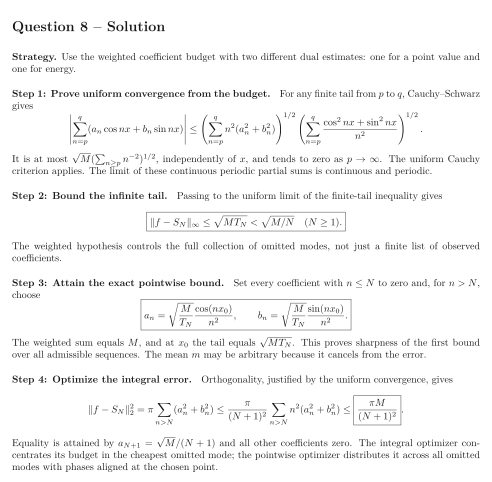
Strategy. Use the weighted coefficient budget with two different dual estimates: one for a point value and one for energy.
Step 1: Prove uniform convergence from the budget. For any finite tail from to , Cauchy–Schwarz gives It is at most , independently of , and tends to zero as . The uniform Cauchy criterion applies. The limit of these continuous periodic partial sums is continuous and periodic.
Step 2: Bound the infinite tail. Passing to the uniform limit of the finite-tail inequality gives The weighted hypothesis controls the full collection of omitted modes, not just a finite list of observed coefficients.
Step 3: Attain the exact pointwise bound. Set every coefficient with to zero and, for , choose The weighted sum equals , and at the tail equals . This proves sharpness of the first bound over all admissible sequences. The mean may be arbitrary because it cancels from the error.
Step 4: Optimize the integral error. Orthogonality, justified by the uniform convergence, gives Equality is attained by and all other coefficients zero. The integral optimizer concentrates its budget in the cheapest omitted mode; the pointwise optimizer distributes it across all omitted modes with phases aligned at the chosen point.