Question 10
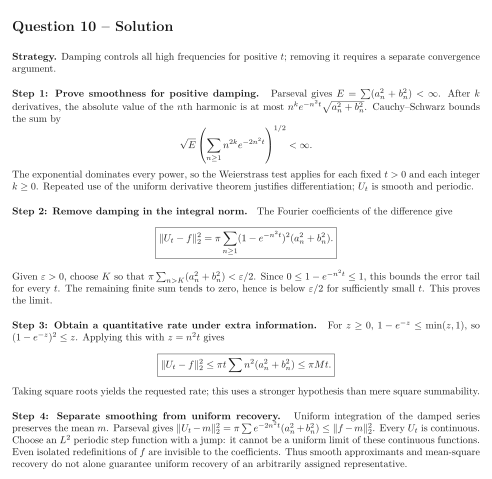
Let be real and periodic with mean and Fourier coefficients . For , define the damped expansion Use Parseval and convergence of Fourier partial sums. This problem concerns the series itself; no partial differential equation is assumed.
Tasks
Prove that for each fixed the series, and every series obtained by differentiating in finitely many times, converge uniformly.
Prove in as using a finite-head and small-tail argument, with an exact coefficient formula for the error.
If , prove .
Show that the mean is preserved and that . Explain why the general assumption alone cannot guarantee uniform convergence to the assigned function as .
Show solutionHide solution
Question 10 – Solution
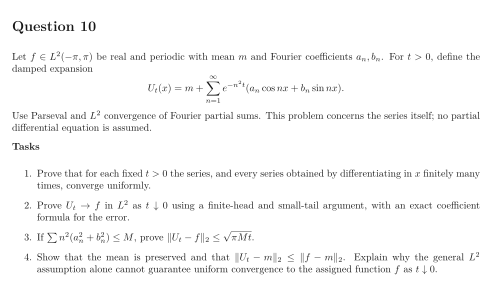
Strategy. Damping controls all high frequencies for positive ; removing it requires a separate convergence argument.
Step 1: Prove smoothness for positive damping. Parseval gives . After derivatives, the absolute value of the th harmonic is at most . Cauchy–Schwarz bounds the sum by The exponential dominates every power, so the Weierstrass test applies for each fixed and each integer . Repeated use of the uniform derivative theorem justifies differentiation; is smooth and periodic.
Step 2: Remove damping in the integral norm. The Fourier coefficients of the difference give Given , choose so that . Since , this bounds the error tail for every . The remaining finite sum tends to zero, hence is below for sufficiently small . This proves the limit.
Step 3: Obtain a quantitative rate under extra information. For , , so . Applying this with gives Taking square roots yields the requested rate; this uses a stronger hypothesis than mere square summability.
Step 4: Separate smoothing from uniform recovery. Uniform integration of the damped series preserves the mean . Parseval gives . Every is continuous. Choose an periodic step function with a jump: it cannot be a uniform limit of these continuous functions. Even isolated redefinitions of are invisible to the coefficients. Thus smooth approximants and mean-square recovery do not alone guarantee uniform recovery of an arbitrarily assigned representative.