Question 1
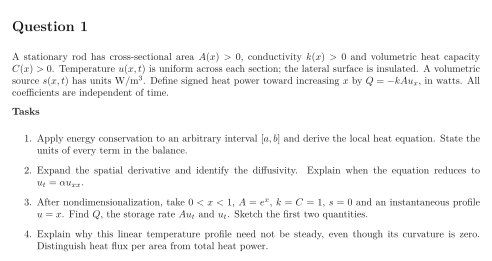
A stationary rod has cross-sectional area , conductivity and volumetric heat capacity . Temperature is uniform across each section; the lateral surface is insulated. A volumetric source has units . Define signed heat power toward increasing by , in watts. All coefficients are independent of time.
Tasks
Apply energy conservation to an arbitrary interval and derive the local heat equation. State the units of every term in the balance.
Expand the spatial derivative and identify the diffusivity. Explain when the equation reduces to .
After nondimensionalization, take , , , and an instantaneous profile . Find , the storage rate and . Sketch the first two quantities.
Explain why this linear temperature profile need not be steady, even though its curvature is zero. Distinguish heat flux per area from total heat power.
Show solutionHide solution
Question 1 – Solution
Strategy. Balance total heat power before dividing by the local cross-sectional area.
Step 1: Derive the conservation law. The stored thermal energy relative to a fixed reference has time derivative . Inflow minus outflow plus generation gives Since this holds on every interval, with Fourier’s law it yields Each local term has units : is , is and is . Each integrated term, including , is in watts.
Step 2: Identify the geometric contribution. Dividing by gives The diffusivity has units . For a homogeneous constant-area rod without a source, this is with constant . More generally, the first-derivative term vanishes when is constant; constant diffusivity additionally requires constant.
Step 3: Evaluate the nondimensional example. Here and , but The signed power is negative because heat moves toward decreasing temperature, which here is the negative direction. Its magnitude increases toward the larger cross section.
Step 4: Interpret the nonzero storage. Flux per unit area is , constant in this example. Total power is , which is not constant. More heat enters a small interval through its larger right face than leaves through its smaller left face, so energy accumulates. Zero curvature alone is a steady-state test only under the coefficient and geometry assumptions that remove the extra term.
See the diagram in the original worksheet below.
