Question 10
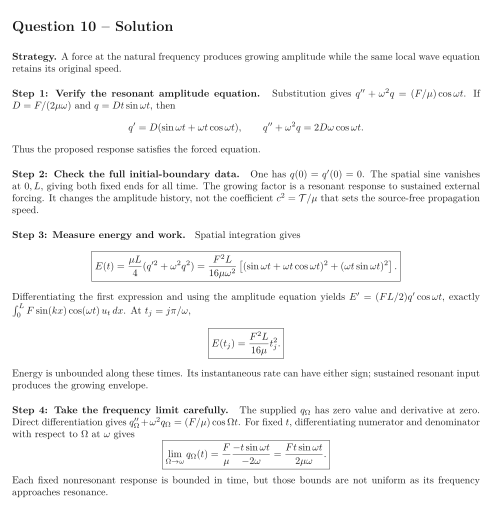
A fixed-end string is driven by Both initial displacement and velocity are zero. Test solutions of the supplied form ; no general separation procedure is required.
Tasks
Derive the scalar equation for and verify .
Check both initial conditions and both fixed-end conditions. Explain why the factor does not alter the propagation-speed parameter of the PDE.
Compute the energy and verify its rate equals the applied work rate. Evaluate the energy at and describe its growth.
Replace the driving frequency by , . Verify the zero-initial-data response and recover the resonant formula as for fixed .
Show solutionHide solution
Question 10 – Solution
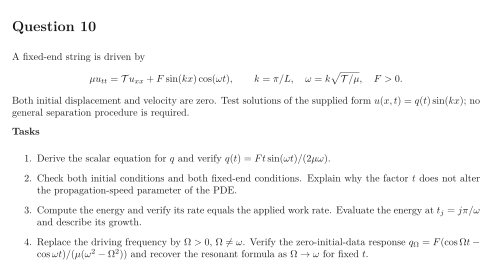
Strategy. A force at the natural frequency produces growing amplitude while the same local wave equation retains its original speed.
Step 1: Verify the resonant amplitude equation. Substitution gives . If and , then Thus the proposed response satisfies the forced equation.
Step 2: Check the full initial-boundary data. One has . The spatial sine vanishes at , giving both fixed ends for all time. The growing factor is a resonant response to sustained external forcing. It changes the amplitude history, not the coefficient that sets the source-free propagation speed.
Step 3: Measure energy and work. Spatial integration gives Differentiating the first expression and using the amplitude equation yields , exactly . At , Energy is unbounded along these times. Its instantaneous rate can have either sign; sustained resonant input produces the growing envelope.
Step 4: Take the frequency limit carefully. The supplied has zero value and derivative at zero. Direct differentiation gives . For fixed , differentiating numerator and denominator with respect to at gives Each fixed nonresonant response is bounded in time, but those bounds are not uniform as its frequency approaches resonance.