Question 1
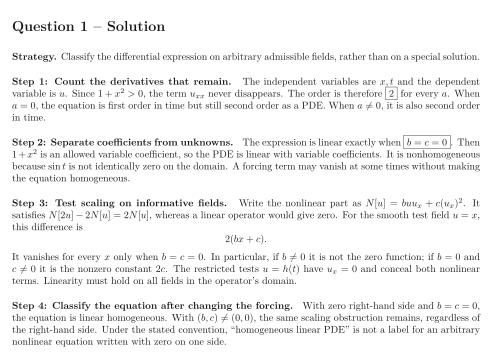
Let be an unknown scalar field on , and let be real constants. Consider the family The order of a PDE is the highest derivative order actually present. A linear PDE has coefficients depending only on the independent variables, and the unknown and all its derivatives occur linearly. For a linear PDE, homogeneous means that its prescribed right-hand side is zero.
Tasks
Identify the independent and dependent variables and determine the order for every , including . Explain why second order need not mean second order in time.
Classify exactly which pairs make the equation linear. In that case, decide whether it has constant coefficients and whether it is homogeneous.
The nonlinear term vanishes on every field independent of . Explain why testing only those fields cannot establish linearity. Give a scaling test that detects each nonzero nonlinear coefficient.
Replace the right-hand side by zero. Explain what changes in the linear case, and why a zero right-hand side alone cannot make a nonlinear equation linear.
Show solutionHide solution
Question 1 – Solution
Strategy. Classify the differential expression on arbitrary admissible fields, rather than on a special solution.
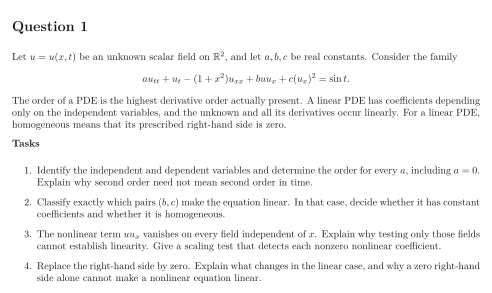
Step 1: Count the derivatives that remain. The independent variables are and the dependent variable is . Since , the term never disappears. The order is therefore for every . When , the equation is first order in time but still second order as a PDE. When , it is also second order in time.
Step 2: Separate coefficients from unknowns. The expression is linear exactly when . Then is an allowed variable coefficient, so the PDE is linear with variable coefficients. It is nonhomogeneous because is not identically zero on the domain. A forcing term may vanish at some times without making the equation homogeneous.
Step 3: Test scaling on informative fields. Write the nonlinear part as . It satisfies , whereas a linear operator would give zero. For the smooth test field , this difference is It vanishes for every only when . In particular, if it is not the zero function; if and it is the nonzero constant . The restricted tests have and conceal both nonlinear terms. Linearity must hold on all fields in the operator’s domain.
Step 4: Classify the equation after changing the forcing. With zero right-hand side and , the equation is linear homogeneous. With , the same scaling obstruction remains, regardless of the right-hand side. Under the stated convention, “homogeneous linear PDE” is not a label for an arbitrary nonlinear equation written with zero on one side.