Question 6
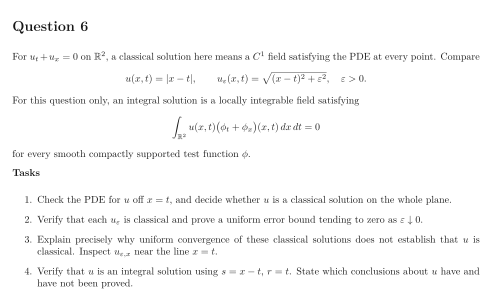
For on , a classical solution here means a field satisfying the PDE at every point. Compare For this question only, an integral solution is a locally integrable field satisfying for every smooth compactly supported test function .
Tasks
Check the PDE for off , and decide whether is a classical solution on the whole plane.
Verify that each is classical and prove a uniform error bound tending to zero as .
Explain precisely why uniform convergence of these classical solutions does not establish that is classical. Inspect near the line .
Verify that is an integral solution using , . State which conclusions about have and have not been proved.
Show solutionHide solution
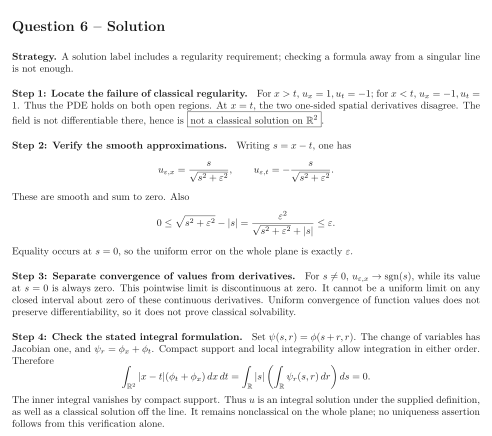
Question 6 – Solution
Strategy. A solution label includes a regularity requirement; checking a formula away from a singular line is not enough.
Step 1: Locate the failure of classical regularity. For , ; for , . Thus the PDE holds on both open regions. At , the two one-sided spatial derivatives disagree. The field is not differentiable there, hence is .
Step 2: Verify the smooth approximations. Writing , one has These are smooth and sum to zero. Also Equality occurs at , so the uniform error on the whole plane is exactly .
Step 3: Separate convergence of values from derivatives. For , , while its value at is always zero. This pointwise limit is discontinuous at zero. It cannot be a uniform limit on any closed interval about zero of these continuous derivatives. Uniform convergence of function values does not preserve differentiability, so it does not prove classical solvability.
Step 4: Check the stated integral formulation. Set . The change of variables has Jacobian one, and . Compact support and local integrability allow integration in either order. Therefore The inner integral vanishes by compact support. Thus is an integral solution under the supplied definition, as well as a classical solution off the line. It remains nonclassical on the whole plane; no uniqueness assertion follows from this verification alone.