Question 8
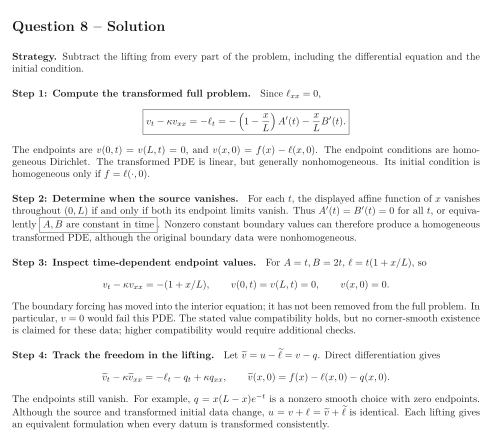
Let on , , with and Assume all data are smooth and . Define a boundary lifting
Tasks
Determine the PDE, endpoint data and initial data for . Classify the homogeneity of its PDE and its spatial boundary conditions separately.
Find the exact condition on for this affine lifting to leave the transformed PDE homogeneous for every .
For , , , compute the transformed source and initial data. Does making the endpoint conditions homogeneous remove the time-dependent forcing from the full problem?
Show that a lifting is not unique. Replace by , where , and derive the new source and initial data. Explain why this is a change of unknown, not a different physical field .
Show solutionHide solution
Question 8 – Solution
Strategy. Subtract the lifting from every part of the problem, including the differential equation and the initial condition.
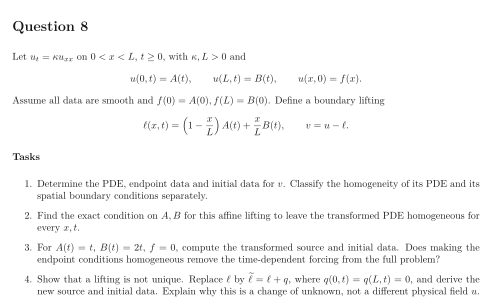
Step 1: Compute the transformed full problem. Since , The endpoints are , and . The endpoint conditions are homogeneous Dirichlet. The transformed PDE is linear, but generally nonhomogeneous. Its initial condition is homogeneous only if .
Step 2: Determine when the source vanishes. For each , the displayed affine function of vanishes throughout if and only if both its endpoint limits vanish. Thus for all , or equivalently . Nonzero constant boundary values can therefore produce a homogeneous transformed PDE, although the original boundary data were nonhomogeneous.
Step 3: Inspect time-dependent endpoint values. For , , so The boundary forcing has moved into the interior equation; it has not been removed from the full problem. In particular, would fail this PDE. The stated value compatibility holds, but no corner-smooth existence is claimed for these data; higher compatibility would require additional checks.
Step 4: Track the freedom in the lifting. Let . Direct differentiation gives The endpoints still vanish. For example, is a nonzero smooth choice with zero endpoints. Although the source and transformed initial data change, is identical. Each lifting gives an equivalent formulation when every datum is transformed consistently.